
Hide My IP

How to Hide Your Identity Fast
If you don’t know already, it’s virtually impossible..and too late…to be anonymous online.
For years, social media sites—and virtually every site online—have been scraping together bits and pieces of your online browsing habits. What for? Mostly to create an eerily accurate picture of who you are. Some people may not realize (or care) about how their data is being used. Marketers and online companies like that!
However, the fact still remains that websites are getting better at marketing to your known online behavior. This means the more data a company has, the more influence it may have over you.
Fortunately, you don’t have to be at the whim of big data. Here’s how you can take internet privacy back into your own hands and surf anonymously.
There are various ways to hide your IP address and your identity, which we’ll cover in a second, but by far the easiest and safest way is with a virtual private network or VPN. And the cost is very reasonable as well.
How a VPN Can Help You be Anonymous
A VPN makes it possible for users to access the web from another location. By masking your IP address and letting you take on another address in a different location, you’re able to browse the web as if you were actually in another country or city. And because websites think you’re browsing from a different region, location-restricted content that may have been unavailable before will suddenly be accessible.
People use VPNs in heavy censorship countries like China to access YouTube, Google, and other blacklisted sites. But even if you don’t want—or need—to access blocked sites, a VPN is still useful as it masks your actual IP address and lets you browse the web with added privacy. It can also help normalize streaming speeds in the event that your ISP is throttling your web traffic. This is a common issue for people with limited data plans.
Think of it like this: if your computer is the starting point and the websites you visit are the destination, a VPN puts a blanket over your web traffic. This means no one can see which sites you’re visiting, and, therefore, can’t spy on you or record your data.
Most VPN services also come with their own encryption protocols, meaning you’re able to browse the web anonymously while having more freedom to access the sites you services you want. With Netflix, Hulu, and other streaming services growing in popularity, being able to pick and choose your VPN protocol makes it easier to stream without having to worry about buffering or slow load times.
More security and staying anonymous online.
While VPNs were once reserved for the technologically elite, they’ve made their way into mainstream culture over the years due to an emerging cultural stance on user privacy. That said, there’s been a heavy influx of fly-by-night VPN providers, and where some VPNs offer a comprehensive service, others come with a host of concerns.
Free VPNs, for example, are typically riddled with privacy problems. In fact, it’s worth avoiding free VPNs entirely. As most take their revenue by either selling data logs or selling user bandwidth (or both), these services are essentially profiting off your privacy. When it comes to free VPNs, YOU are the product—not the other way around.
We’ve reviewed dozens of VPNs and highly recommend one of these top-rated providers:
| VPN | Devices | Countries | From | Money-back | |
|---|---|---|---|---|---|
| Up to 10 | 140+ | $3.49/mo | 30 days | See Plans | |
| Unlimited | 100 | $2.49/mo | 30 days | See Plans | |
| Up to 10 | 149 | $3.49/mo | 30 days | See Plans | |
| Up to 7 | 100+ | $2.19/mo | 45 days* | See Plans | |
| Unlimited | 110+ | $2.49/mo | 30 days* | See Plans | |
| Up to 10 | 113 | $2.99/mo | 30 days* | See Plans |





Prices are the lowest advertised monthly rate on a long-term plan and may change. * CyberGhost: 14 days on monthly plans. ExpressVPN: new customers only. IPVanish: yearly and 2-year plans only.
An anonymous VPN can help you reclaim your digital privacy and browse the web freely—the way it was meant to be. Just remember that every site you visit leaves a trace, so if you truly want to hide your IP, you’ll need to use a VPN on every internet-enabled device you own.
Hide IP explained: It’s not as complex as it might sound
Obviously, you got to this page for a reason, which is that you’ve heard a few things about IP addresses, and you may be confused. The link we provided before on IP address basics (to an article called, VPN 101) is something you should check out.
Hiding your IP address is basically borrowing a different IP address to go anywhere on the internet and stay hidden. You’re masking your real IP address with a borrowed one.
The reasons why you might want to mask your IP address may include: To hide your geographical location, prevent Web tracking, avoid a digital footprint, or bypass any content filters, bans, or blacklists.
There are a few ways to hide your IP address…that unique number assigned to the network connection on the computer.
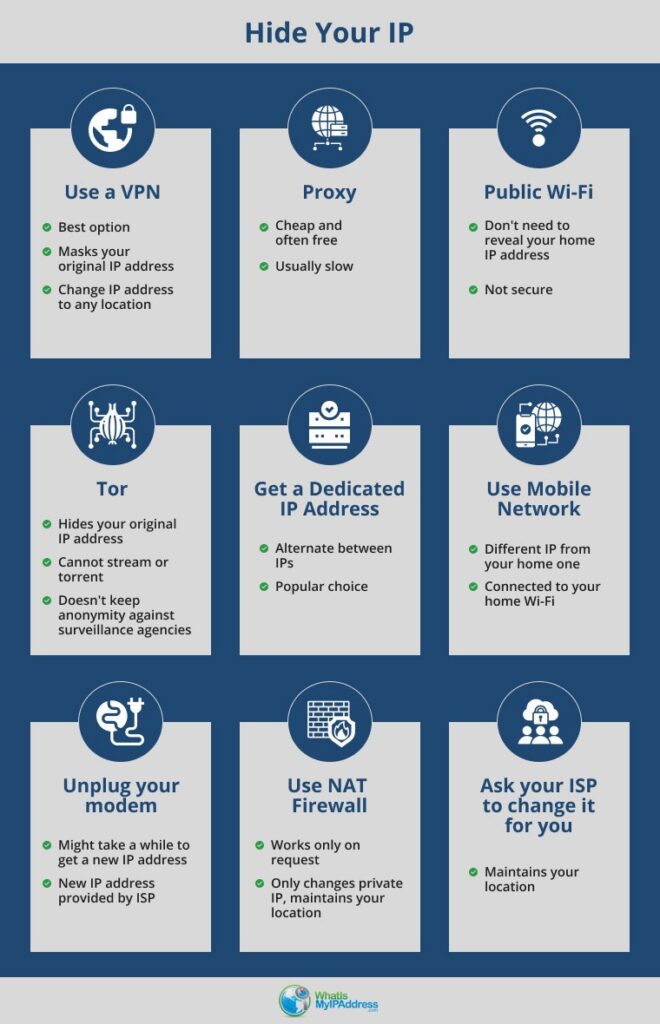
9 Ways to Hide Your IP Address:
1.Use a VPN Service – The Best Way
Sign up for one of these services and when you go online, you’ll be showing the world a different IP address…one that’s on loan from the service you’re using. What you must understand is that A VPN is a versatile tool to protect your privacy and enhance your internet experience. You can use it to change IP address, prevent spying on IP address, or even hide IP while gaming to avoid online threats. For entertainment, VPNs are an excellent option to hide IP while streaming, granting access to geo-restricted content.
There are many more advantages to using a personal VPN service over a proxy such as high-speed bandwidth, usability, a secure connection, private access to blocked sites, and the ability to choose the country and city where you appear to be.
There are hundreds of VPN companies you can choose from…many of them shady and/or poor quality.
No worries.
We’ve reviewed the top VPNs out there and feel these are the best of the best:
| VPN | Devices | Countries | From | Money-back | |
|---|---|---|---|---|---|
| Up to 10 | 140+ | $3.49/mo | 30 days | See Plans | |
| Unlimited | 100 | $2.49/mo | 30 days | See Plans | |
| Up to 10 | 149 | $3.49/mo | 30 days | See Plans | |
| Up to 7 | 100+ | $2.19/mo | 45 days* | See Plans | |
| Unlimited | 110+ | $2.49/mo | 30 days* | See Plans | |
| Up to 10 | 113 | $2.99/mo | 30 days* | See Plans |
Prices are the lowest advertised monthly rate on a long-term plan and may change. * CyberGhost: 14 days on monthly plans. ExpressVPN: new customers only. IPVanish: yearly and 2-year plans only.
Don’t know which VPN is right for you? Try our VPN Simplifier.
2. Proxy
Another method to change your IP address is by connecting to a proxy service. These services are cheap and are often free as well. While they can change your IP location, they come with problems of their own. These services are often very slow and can ruin your browsing experience. They’re also full of leaks. A simple Web-RTC leak is enough to reveal your actual physical location to the website.
That’s why choosing a proxy service might not be the best option for your needs.
3. Public Wi-Fi
An easy option you can use is to go online using a public Wi-Fi network. While it may save you from revealing your home IP address, it does require you to leave the comforts of your room and sit at a café or a bar somewhere else. Even then, the websites might be able to locate the city where you are connecting from, and you won’t be able to access websites that are not available in your region.
Moreover, there’s also the chance that you can get hacked! Public Wi-Fi networks are unsecured networks and are considered dangerous habitats where hackers and cybercriminals could be lurking around in search of easy prey.
4. Tor
Before the VPNs and proxies came around, those who worried about their privacy used to use Tor. Tor (which stand for The Onion Router) is a browser that is different from any other browser you’ve ever used. This service is skilled at routing your traffic over hundreds of different nodes to hide your original IP address.
Tor is an amazing tool if you want to keep your IP address secret. However, the service is not good for streaming or torrenting because the nodes are often located in the wrong regions. Also, Tor is on the watch of the FBI and other surveillance agencies, which might mean that if your browsing activities are borderline illegal, you might not be 100% anonymous on Tor.
5. Get a Dedicated IP Address
A lot of people choose to use a dedicated IP address rather than the shared IP given to them by their ISP (Internet Service Provider). This gives you the option to alternate between your home IP address and your dedicated IP address. You can also choose to get a dedicated IP address from the location of your choice, giving you access to many different options on the internet.
6. Use Mobile Network
Like your home internet connection, your mobile network also offers you an IP address, albeit a different one. Just like in the case of the public Wi-Fi network, you can choose to use your mobile network if you temporarily wish to use a different IP address.
7. Unplug your modem
Your IP address is assigned to you by your Internet Service Provider. Most ISPs offer dynamic IP addresses, which means that if you unplug your modem and re-plug it, chances are that you’ll be assigned a different IP address. You may have to wait a bit of time for the DHCP lease (your IP address assignment, that is) to expire, though, but it is a good way to get a new IP address if need be.
8. Use NAT Firewall
A NAT firewall (for Network Address Translation) operates on a router to protect private networks. A NAT firewall allows only internet traffic to pass through if someone on the network requested it.
This is an effective method to change your private IP address. However, private IP addresses are different from public IP addresses. This means that only the private IP of your device shall change, and it would have no impact on what the websites see when they track your physical location.
9. Ask your ISP to change it for you
As a final resort, you can contact your ISP and ask them to change your IP address. Again, this wouldn’t have any impact on your web location, and it would reveal all the information that your previous IP address was also revealing. This method would definitely not work like a charm, the way a VPN would.
How to check if your actual IP address is hidden.
Regardless of whichever method you choose from above, make sure to use the WhatIsMyIPAddress.com tool to check if it’s working or not—it’s the leading IP-lookup resource on the internet. After all, there’s no point in using these methods if your actual IP address is still exposed on the internet.
Check out PureVPN.
One VPN service you should check out is PureVPN. PureVPN delivers the advantages of security, privacy, and online access people want and need. It offers advanced online privacy and security tools and provides access to your favorite streaming websites. Wherever you are, you can connect to any of their 6,000 servers in over 100 countries. PureVPN also delivers top-level security features, including end-to-end encryption, Split Tunneling, and Internet Kill Switch. Better yet, you can even get a dedicated IP address with PureVPN. You can get all the information you want on the PureVPN website.
In conclusion…
The best way to hide your IP is by using one of our recommended VPNs for high-speed bandwidth, usability, a secure connection, private access to blocked sites, and the ability to choose the country and city where you appear to be.
Here are the best VPNs we’ve found:
| VPN | Devices | Countries | From | Money-back | |
|---|---|---|---|---|---|
| Up to 10 | 140+ | $3.49/mo | 30 days | See Plans | |
| Unlimited | 100 | $2.49/mo | 30 days | See Plans | |
| Up to 10 | 149 | $3.49/mo | 30 days | See Plans | |
| Up to 7 | 100+ | $2.19/mo | 45 days* | See Plans | |
| Unlimited | 110+ | $2.49/mo | 30 days* | See Plans | |
| Up to 10 | 113 | $2.99/mo | 30 days* | See Plans |
Prices are the lowest advertised monthly rate on a long-term plan and may change. * CyberGhost: 14 days on monthly plans. ExpressVPN: new customers only. IPVanish: yearly and 2-year plans only.
Don’t know which VPN is right for you? Try our VPN Simplifier or compare VPNs.