
How Starlink is Creating Both Global Connectivity & Risk

Every time a new technology comes onto the scene, society has to decide what to do with it. New technologies can be exciting, but a healthy sense of skepticism is important. Wholeheartedly embracing a new technology just because it has a lot of potential for good is a risky way to interact with developments in tech.
Starlink, a satellite internet service that was founded in 2015, has a goal of providing high-speed, low-latency internet to areas of the world that have previously been too remote or underserved to have consistent, powerful internet access. Starlink is powered by over 7,000 low Earth orbit (LEO) satellites.
You’ll generally hear two perspectives on Starlink:
- Starlink is democratizing internet access by providing remote, underserved regions with reliable internet access
- Starlink poses a serious risk to global security because of security vulnerabilities and the erratic behavior of its CEO, Elon Musk
Ultimately, this is not a situation where the truth is “somewhere in the middle.” Rather, this is a scenario in which both of these statements are true: Starlink represents the transformative potential for global connectivity, and it creates serious new vulnerabilities.
Both of these realities coexist, and they do not cancel each other out.

How Starlink is making the world more interconnected
Starlink aims to address a serious issue: the damage caused to communities and individuals because of a lack of internet access. This includes offering standard internet access to underserved populations, as well as crisis-based access during catastrophic global events.
Starlink’s potential to provide equitable access to the internet
Rural, remote, and developing regions each face unique challenges, but they have this one thing in common. Without reliable, affordable internet access, local economies struggle to keep up with communities that have consistent access to the internet.
- 11.5 million American households lack internet access (about 8.8%)
- Globally, one-third of the world’s population is unconnected from the internet
- During COVID-19’s school closures, many districts saw that as many as 25% of their students had poor or no internet access
Unequal access to the internet is furthering the divide between the wealthy and the working class. According to the International Monetary Fund, this causes two kinds of problems:
Within countries. Income inequality and inequality of opportunity may worsen—even in advanced economies—because disadvantaged groups and people who live in rural areas have more limited Internet access. The disparity between men and women in their labor force participation, wages, and access to financial services may increase where there is a gender gap in access to the Internet. This could be the case in many emerging and developing countries where fewer women than men own a mobile phone.
Between countries. The relatively low Internet access might depress productivity in emerging and developing countries. IMF staff research finds that a one percentage point increase in the share of Internet users in the population raises per capita growth by 0.1–0.4 percentage points in sub-Saharan Africa. The COVID-19 pandemic demonstrates that having reliable Internet allows some businesses to continue operations amidst lockdowns, which keep economies running.
Starlink aims to address this divide and improve access to the internet for rural, remote, and developing communities.
Advocates of the company argue that the Starlink Community Gateway as a revolutionary solution that delivers fiber-like speeds (up to 10 Gbps) and low latency to remote areas, effectively bridging the digital divide.
In Unalaska, Alaska, the technology provided reliable high-speed internet to thousands of residents with over 99% uptime, transforming economic and educational opportunities on the remote island. To many, Starlink as a game-changing technology that can connect previously isolated communities to the global digital economy.
Why internet access equality matters
Without equitable access to the internet, communities struggle with:
- Reduced economic opportunities and employment options
- Fewer educational opportunities and resources
- Lack of access to healthcare and telemedicine
- Exclusion from government services and civic participation
- Limited financial inclusion and banking options
- Social isolation and weakened community connections
- Compromised emergency communications during disasters
- Reduced agricultural and business productivity
How Starlink provides internet access to these communities
Starlink operates through a constellation of satellites positioned in low Earth orbit (LEO), significantly closer to the planet than traditional satellite internet systems. While conventional satellite internet relies on geostationary satellites orbiting 35,786 km above Earth, Starlink uses thousands of smaller satellites that orbit at about 550 km altitude. This reduced distance decreases the time required for data transmission, addressing latency issues that previously made satellite internet impractical for many applications.
The system functions through a network of over 7,000 satellites that continuously orbit the Earth.
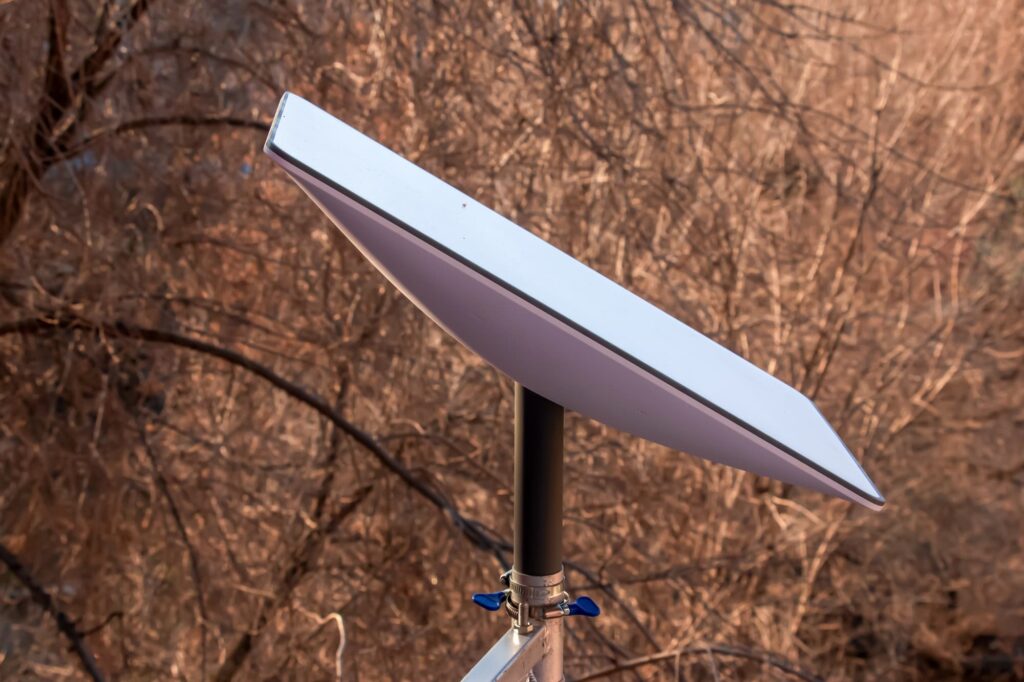
For Starlink users, the system requires a satellite dish and router that connects to the overhead satellites. The equipment needs an unobstructed view of the sky to function properly Starlink. This setup allows internet access in areas where traditional infrastructure, such as fiber optic cables or cell towers, is absent or too expensive to install. The technology enables communities in remote locations to access internet services that were previously unavailable or unreliable through conventional means.
Starlink’s ability to support populations in crisis
Because accessing Starlink doesn’t require any traditional installation methods, it can be fast-tracked during times of crisis.
For example, Starlink’s parent company SpaceX has provided ongoing internet access to Ukraine’s military and civilians throughout the ongoing conflict over Ukrainian lands that Russia wants to control. In areas where the internet infrastructure has been destroyed or seriously damaged, Starlink’s LEO satellites can provide faster access to essential information, data, and communication. All the user needs is a Starlink terminal to give them access to the satellite network.
Similarly, Starlink has been deployed in areas that have suffered natural disasters, including hurricanes, earthquakes, and wildfires. Starlink’s humanitarian efforts include distributing Starlink terminals to communities that need immediate communication access.
This rapid deployment capability demonstrates one of Starlink’s most significant advantages over traditional internet infrastructure. While rebuilding damaged fiber networks or cell towers can take weeks or months, satellite internet can restore connectivity within hours of terminal delivery.
However, this same speed and independence from ground infrastructure also highlights the extent to which affected populations become dependent on a single private company’s technology and policy decisions during their most vulnerable moments.

The real and potential risks of dependence on Starlink for connectivity
There is no question about it: Starlink has the potential to do immense good in the world. In some places, they are already doing it!
However, critics are right to bring up some points of concern. It goes back to that earlier premise: If you embrace new technology without examining it closely for risks and flaws, you may end up in a situation that you never expected.
Cybersecurity vulnerabilities at Starlink
Starlink’s massive size and complexity contribute to cybersecurity risks at a significant scale.
Think about the task of protecting thousands of satellites and hundreds of ground stations against security risks, including tampering and hacking. Each satellite must be secured and monitored. Meanwhile, ground stations are located in multiple countries, which means that there is no single framework for regulatory compliance and security.
These are a few of the reasons why the cybersecurity challenges of Starlink extend beyond traditional internet infrastructures. A successful attack on key satellite components or ground control systems could potentially affect internet access across entire continents.
If you spend much time on Reddit or YouTube, you’ll find a lot of guidance on how to protect yourself from security risks if you use Starlink’s systems.
The potential for widespread disruption through targeted attacks represents a particularly serious concern. State actors or sophisticated cybercriminal groups could target the satellite network’s command and control systems. They could potentially take large portions of the constellation offline.
The satellites themselves, while hardened against space debris and radiation, present novel attack surfaces that security researchers are still learning to understand. Ground stations, which serve as critical links between the satellite network and terrestrial internet infrastructure, represent high-value targets that could be compromised through both cyber and physical attacks.
Transparency around Starlink’s security protocols and incident response procedures remains notably limited. Starlink’s security measures are largely proprietary and undisclosed, and this lack of transparency makes it difficult for cybersecurity experts, government agencies, and potential users to assess the actual security posture of the network.
When security incidents do occur, the limited public information about response procedures creates uncertainty about how effectively threats are being addressed and whether users are adequately informed about risks to their data and communications.
The risk of geopolitical dependence on Starlink
Critics of SpaceX, Starlink, and Elon Musk have raised concerns about the geopolitical risk of nations depending on one private company for internet access.
For example, when President Trump wanted to take control of Ukraine’s mineral deposits via negotiations with Russia, the US made it clear that they could cut off the country’s access to Starlink if a deal was not reached. (Musk later stated that they had no plans to do so.)
In India, concerns about Starlink center on national security vulnerabilities arising from the service’s deep integration with the U.S. military. This concern may not raise many red flags for American users of Starlink, but international communities express hesitation. Indian critics of Starlink raise questions about the company’s extensive military contracts. That includes deals worth hundreds of millions of dollars for missile tracking, military communications, and battlefield coordination capabilities.
Given India’s sensitivity around telecommunications security—the country has already banned Chinese companies from this sector and requires permits even for satellite phone use—many question whether India can maintain control over a critical communication infrastructure owned and operated by a foreign entity with strong military ties.
Concerns about Musk’s erratic actions
It’s also important to note that Musk’s behavior tends to be erratic and unpredictable.
Musk’s public statements and policy decisions have frequently shifted without warning, creating uncertainty for users and governments alike. His tendency to make major announcements via social media, change company policies based on personal opinions, and engage in public disputes has raised questions about the stability of critical infrastructure under his control.
For instance, his acquisition and subsequent dramatic restructuring of Twitter/X demonstrated how quickly he can alter the fundamental operations of platforms that millions depend on. When essential communication services are subject to the whims of a single individual’s decision-making style, it creates an additional layer of risk.
Many are concerned that the risk of having Musk at the helm of Starlink extends beyond technical vulnerabilities. It now includes unpredictable human factors in infrastructure management.
When it comes to Starlink, both benefits and risks coexist
Starlink is not the first leap in technology to be accompanied by major benefits and risks. Consider these examples of technologies that are commonly accepted today, but have been plagued by concerns:
- Nuclear technology powers cities, and it also creates weapons of mass destruction and long-term radioactive waste disposal challenges
- The internet has revolutionized global communication and commerce. But it has also enabled cybercrime, online harassment, disinformation campaigns, and new forms of surveillance
- Social media connects people around the world. But it has simultaneously led to the increase of mental health issues, erosion of privacy, and political manipulation
- Artificial intelligence is making massive changes to the ways that humans work. It automates dangerous tasks and improves human performance. But there are serious concerns about job displacement, algorithmic bias, and the potential loss of human agency
Humans don’t tend to reject new technologies because they pose risks to our security and wellbeing. So what can we do?
The challenge with Starlink isn’t choosing between its benefits and risks—it’s learning to manage both simultaneously. Rather than waiting for perfect solutions or dismissing legitimate concerns, we will have to develop frameworks that harness Starlink’s transformative potential while actively mitigating its vulnerabilities.
This means creating international oversight mechanisms, establishing transparency requirements for security protocols, and ensuring that no single entity—whether corporate or governmental—holds unchecked power over global communications infrastructure.
Related Articles
- All
- Easy Prey Podcast
- General Tech Topics, News & Emerging Trends
- Home Computing to Boost Online Performance & Security
- IP Addresses
- Networking Basics: Learn How Networks Work
- Online Privacy Topics to Stay Safe in a Risky World
- Online Safety
- Uncategorized

What is ID.me? One Day, You Might Need to Know.
If a friend asked you, what is ID.me, would you be able to answer? You really should,...
[Read More]
A Former Fraudster’s Tips for Protecting Your Personal Information in a Connected World
Technology is evolving so fast and is ever increasingly integrated into our world. It’s becoming less and…
[Read More]
Awareness and Safety Go Hand-in-Hand: Tips to Protect Yourself
Scams are often (though not always) technology-based, and physical danger happens in the physical world. But both…
[Read More]
We Created EasyPrey.com Scam Help Page to Help You
WhatIsMyIPAddress.com and our sister website, EasyPrey.com, focus on providing content and links to information and resources for...
[Read More]
EasyPrey.com Resources for Scam Victims
We’ve compiled a list of resources for all victims (and near victims) of scams, fraud, and identity…
[Read More]
The BBB Scam Resources Are There to Help You!
The Better Business Bureau is on YOUR side, helping consumers with real-time scam tracking, which you can...
[Read More]