
Awareness and Safety Go Hand-in-Hand: Tips to Protect Yourself
Scams are often (though not always) technology-based, and physical danger happens in the physical world. But both types of threats often begin in the same way – with someone testing your awareness and willingness to stop and think. Awareness and safety go together, online and in the real world. If you’re more aware and prepared to respond to any type of threat, you’re a more challenging target.
See Personal Safety with S. Gale Bleth for a complete transcript of the Easy Prey podcast episode.
S. Gale Bleth is a personal safety educator, certified Rape Aggression Defense (RAD) self-defense instructor, and author of A.W.A.R.E.: A Personal Safety Playbook for Leaving the Nest. Her background is in higher education, where she worked as a trainer for the campus police department and realized she loved teaching. While she was working on campus, she tried to sign up to take a RAD class, but accidentally signed up to be a trainer instead. She loved the experience and has been teaching women’s self-defense ever since.
After sixteen years with the campus police, Gale got the opportunity to become a crime prevention specialist with the Hayward Police Department. There, she took what she taught in the twelve-hour RAD course – which included education, hands-on practice with self-defense movements, and a simulation experience – and created a simplified, ninety-minute class about safety. And she ended up teaching that class so much that she decided to put that content into a book.
The A.W.A.R.E. Framework
When Gale decided to write the book, she thought “Aware” would make a good title. She didn’t plan to put it into an acronym. But one day, it occurred to her that there had to be an acronym. The book has a lot of RAD components, and the E could stand for “escape.” From there, it wasn’t hard to create the full acronym. You have to be Alert, then Watch, then Assess the situation, Respond to that assessment, and decide whether to stay or Escape.
The best way to illustrate this is with an example. Say Gale is sitting at home. She tries to always be Alert to her surroundings, which is what allows her to hear the explosion. Once she hears it, she’s going to move to Watch and look outside to gather information. When she looks out the window, she sees smoke. Now she can Assess. Is it getting bigger? Can she hear fire trucks? Is the wind blowing her direction? Based on that assessment, she’ll Respond – deciding that it’s under control, or that the fire is headed towards her house and she needs to Escape.
For a more everyday example, imagine a hypothetical college student named Lily. She was never much into parties, but her roommate parties all the time. One day the roommate invites Lily to a party, and Lily decides to go. But she’s Alert – she knows her roommate likes frat parties and there may be risks. When she gets there, she’ll Watch to see what’s going on at that party. Based on what she sees, she’ll Assess whether it’s safe and if she wants to be there. From there, she can Respond by staying but keeping a close eye on her drink or going back to her dorm and Escaping.
The Awareness Color Code
We all have gut feelings about when things are dangerous or unsafe. We can feel when something isn’t right. If you can’t, you’re not paying enough attention. Those gut feelings can clue us into a lot. One of the things Gale talks about in her book is the color code of awareness. Everyone has a color of their awareness of their surroundings.
You can kind of tell danger, you can feel it … and if you can’t then you’re not aware enough of your surroundings.
Gale Bleth
If you’re in white, you’re not aware. You’ll miss a lot of the more subtle indications that something is wrong. Yellow is not highly activated or anxious, but still paying attention to changes or gut feelings. Orange is the next step up, when you notice something is going on. In the example with the explosion, the sound put Gale into orange. It’s when you feel or notice something might be a threat and start taking steps to Watch for more info and Assess the level of risk. Red is when you look out the window and see the fire coming towards you – when you’re running or fighting for your life, you’re in red.
Ideally you should be in yellow most of the time. White is when you’re completely unaware and not paying attention – even basic situational awareness will protect your safety and put you in yellow. The last color code is black. That’s when something happens and you’re so scared and overwhelmed that you just shut down. When you’re in black, you couldn’t respond even if you wanted to.
A Healthy Level of Awareness
Being completely oblivious to your surroundings is obviously dangerous. But at the other extreme, it’s not healthy to assume every door opening is a person coming to attack you. You need to have enough awareness to protect your safety without tipping over into paranoia. And that’s where education comes in. The majority of your safety is knowledge and education. If you don’t learn how to be aware and how to respond to situations, you’re going to go straight from white to black. You won’t have anything in between because you won’t know what to do.
90% of your safety is education and knowledge.
Gale Bleth
When Gale gives presentations, she often gets questions about what to do in specific scenarios. And the answer is almost always to learn more about what you should be doing. Take a self-defense class or read a book like A.W.A.R.E. It’s possible to be in yellow and go straight into black because a situation is so unexpected and out of the ordinary. The more you learn, the more knowledge you’ll have, and the more likely you’ll be able to respond to a situation instead of getting overwhelmed.
Last year, Gale went to a concert in a big stadium. While she was waiting for the show to start, someone would come up on stage every fifteen minutes and point out the escape routes. Gale listened because she wanted to know what to do if she needed to escape. But plenty of people were just on their phones, not paying attention. If something happened, people who knew what to do would be able to react, but those who didn’t were in danger of getting overwhelmed and paralyzed.
Basic Awareness and Safety
If you’re just starting to work on your awareness for better safety, it can be challenging to try and pay attention to everything at once. But you don’t actually have to. Gale encourages people to think like law enforcement. It’s always a good idea to find another way out of any location. Otherwise, if a threat comes in the same door as you, you don’t know where to go.
Also watch for things and people that are out of place. If it’s 95 degrees out and someone walks in wearing a big coat, that’s suspicious. If a person is pacing, or sweating, looking nervous, or just seems out of place, be on alert. That’s a good time to think about whether you want to stay or leave. Many of us were trained since we were kids to not react to people who are different because that’s rude. But you have to act on your own internal warnings.
Gale worked in a downtown area with a lot of homeless people. A lot of them would talk to themselves or be angry, but for the most part they weren’t violent. She was always friendly. She walked with confidence, and if anyone looked at her, she smiled at them. If they talked to her, she would say something acknowledging like, “I hear you,” or “have a good day.” But if they kept trying to talk to her, she’d have to stand up for herself and say she was going to leave or encourage them to keep walking. Usually just using your voice will work, but not always. That’s why only 90% of safety is awareness and knowledge – the other 10% is knowing how to defend yourself if you have to.
Don’t Stare At Your Phone
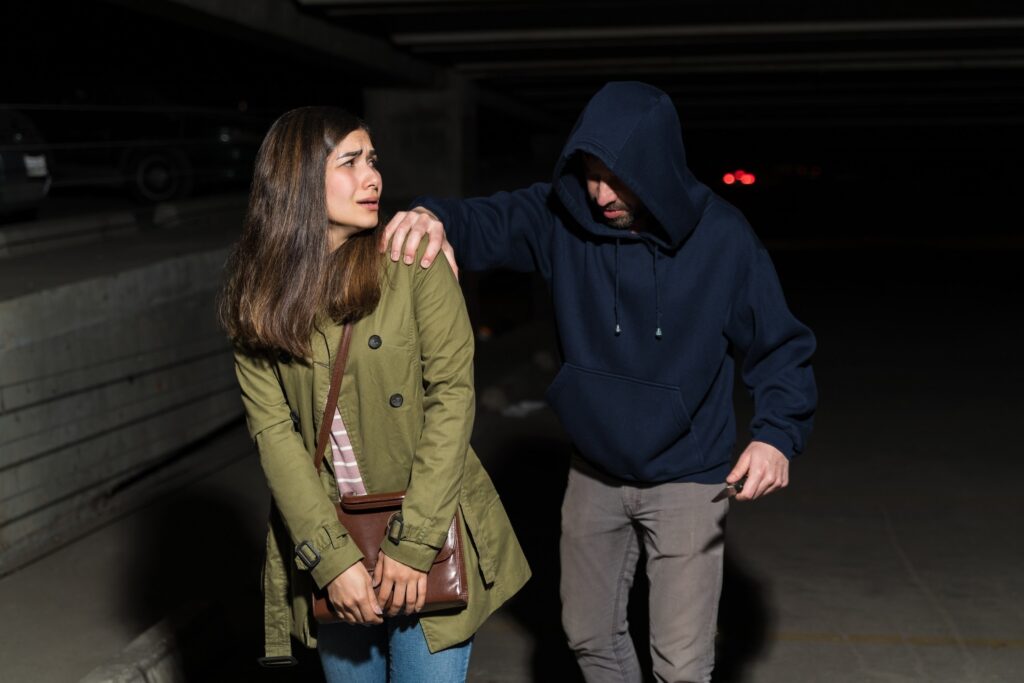
One universal thing about both safety and awareness is that just staring at your phone is bad. You have to be aware of your surroundings, especially in situations where something dangerous could happen. If you’re walking through a parking lot staring at your phone, someone could grab you, or your purse, or your phone. Or you could get hit by a car.
Gale is never on her phone when she parks her car. She travels a lot, and when she parks her car in the parking garage at the airport, she doesn’t get out her phone. Walking through the parking garage and the airport with her luggage, she’s not on her phone. When she gets on the elevator or tram, she’s not on her phone. It isn’t until she gets to an area with a lot of people and she needs her boarding pass that she gets it out.
Having your phone out puts you at risk. You’re not aware of your surroundings, and it’s very obvious that you’re staring at your phone instead of being aware and watching out for your safety. People who want to commit harm will notice that. If you’re not aware of your surroundings, you’re in danger. You’re in white, oblivious. You just can’t be on your phone. That’s so important – don’t be on your phone if you can at all help it.
You’re in a vulnerable situation if you’re not aware of your surroundings.
Gale Bleth
How to Be a Good Witness
Awareness can protect your safety. But it can also help others. If you’re not the target of a crime or an attack but you witness it, that’s a crucial role. A lot of people see something happen and think that they should have done this or that. But it’s actually more important to be a good witness than a hero. A good witness can give enough information for the police to find the perpetrator.
It’s better for you to be a good witness than to be a hero.
Gale Bleth
But it’s really hard to be a good, credible witness if you don’t exercise the skill. You can do it while standing in line at the grocery store. Say somebody walks in and you only see them for a second before they turn down an aisle. Try to describe them. “They were wearing dark clothing” isn’t helpful. But if you can say, “He was maybe 5’ 9” or 5’ 10”, wearing a black hoodie and jeans and his shoes were red,” that’s a good witness.
Details are helpful to police. What color was their skin? Not necessarily ethnicity, but were they very pale or more olive? What color was their hair, and what was the style? Roughly how tall were they? If you heard their voice, did they have an accent? What direction did they go? If they were in a car, what color was it and how many people were in it? Anything distinctive, like tattoos or dents on a car, is especially helpful. Don’t embellish or exaggerate, but any specific details are really useful to law enforcement.
You can find Gale Bleth on stay-aware.com and on Facebook, Instagram @stayaware_sgb, and LinkedIn. Get the book A.W.A.R.E.: A Personal Safety Playbook for Leaving the Nest on Amazon.