
Is Your Online Love a Con Artist? Spotting Romance Scam Signs

While you’re looking for your perfect mate online, you need also be on the lookout for several of the many signs of a romance scam.
It’s a very sad fact—yet a fact of online dating—that scammers and con artists are actively look for their victims online, whether dating platforms or places like Facebook. The facts tell the story. The Federal Trade Commission in 2021 received nearly 80,000 reports and complaints about romance scams, which added up to around $550 million in losses! The number of reports increased by 80% from the year before.
Romance Scams by the Numbers
$1.3 Billion
amount of money lost to romance scammers in the last five years
$4,400
median reported loss to romance scammers
#11
romance scam rank by number of victims
#5
romance scam rank by amount lost
And that’s just what’s reported! Scams, fraud, and cybercrime are still vastly under-reported. Some estimates suggest only 16% of actual fraud are reported and included in the romance scam statistics7. So the incidents and losses may actually be much, much higher.
Online dating is here to stay.
Statistics show that 59% of Internet users feel that online dating is a good way to meet people…and that’s up from 44% in 2005. But along with that number is this: Almost 55% of that group believe they’ve seen fake personal profiles and more than a quarter of them have had online interactions that creeped them out.
Web of deceit.
The classic Internet romance scammer plays on your emotions—your need for a romantic friend—to lure you in. They don’t use their real names or actual pictures. They make up a name, or steal the likeness of someone else…someone you might feel safe about, such as a soldier, social aid worker, or a professional working abroad.
Scammers go to great lengths to win you over and gain your trust and affection, just as a sincere romantic interest would do to win your heart. The lying Lothario will charm you with sweet words, pledges of affection, and may even send gifts to you. They’re often not in the same city as you are, which means actually meeting them will always have to wait.
If they earn your trust, they might talk you into sending pictures or videos of yourself, possibly of an intimate nature. But for sure, they will eventually get around to you asking for money or financial help. It could be for a supposed medical emergency, or to help them get their business out of trouble. There are endless, tall tales, all semi-plausible, that they could offer up to you. And if you’ve become emotionally attached to the person, you might give in. Thousands of people do.
Or maybe you won’t. But if you decline to send money, they might remind you of those half-naked pictures and videos you sent them, and they’ll ask for hush-money to keep them private. And the charade is over.
Do not think this is all an exaggeration. It’s a fact—women have given tens of thousands of dollars to men who seemed deserving of it…but weren’t.
Profile of a Romance Scam
You don’t have to be looking for love to be a victim of a romance scam. In fact, over a third of online romance scam victims in 2021 were approached on Facebook or Instagram, not a dating app or website.
Your age does affect how scammers will approach you. Adults ages 18-59 are most likely to be initially contacted by romance scammers on social media (31% of reports)3 or through another website or app (30% of reports)3. Adults age 60 or older are more likely to be initially contacted by scammers via phone call (24% of reports)3, but a website or app is the second most likely point of contact (21% of reports)3.
Scammers have favorite ways to get payments from people. Gift cards are the most common way scammers ask for your money (24% of reports)1. They also like cryptocurrency (19%), payment apps like Venmo and Zelle (15%), and wire transfers or bank transfers (14%)1. But even though gift cards are the most frequently reported, they only account for 7% of losses to romance scams. The biggest losses happen when the payment method is cryptocurrency (24%) and wire transfers or bank transfers (27%)1.
Romance Scammers’ Favorite Lies
Looking at romance scam statistics, scammers re-use the same stories to gain your trust (and your money). Here are a few of their favorite lies:1
I’m sick, hurt, or in jail or my loved one is sick, hurt, or in jail. This is the most common story, told in 24% of romance scam cases. They play on your heartstrings so you’ll send money.
I can teach you to invest. This lie shows up in 18% of romance scam reports. It’s the hook for a combination of romance scam and investment scam known as “pig butchering.”
I’m in the military and stationed far away. This lie is sometimes called a military romance scam. It’s a believable story for why you can’t meet them in person (and sometimes why you can’t call or video chat). At 18% of reports, it’s tied for third most common scammer story.
I need help with an important delivery. Another lie tied for third at 18% of reports, this one is another way to get at your money.
I know we’ve never met, but I want to marry you. In 12% of reports, victims reported their scammers offered to marry them. It’s an emotional manipulation tactic to keep you on the hook.
I’ve come into some money or gold. A classic scam story that shows up in 7% of romance scam cases. This stroke of “good luck” for them will end up with you losing money.
I work on a ship or oil rig. At 7% of reports, this story is less common. But it’s another great excuse for the scammer to never meet you in person.
You can trust me with your private pictures. Scammers tell this lie in a specific variation of romance scams called sextortion. It showed up in 3% of reports.
Profile of a Romance Scam Victim
Think you know what the average romance scam victim looks like? Take a look at these romance scam statistics for victims to see if you’re right.
1. Any Age
Some people think romance scammers mainly target the elderly. But victims can actually be any age. Adults ages 18-59 are actually 13% MORE likely to fall for a romance scam than adults older than 60.3 But even though younger adults fall for it more, older adults tend to lose more money – the median losses for older adults are nearly twice that of their younger counterparts.3
Romance scams can even target children. The most common age range for victims of sextortion, a type of romance scam, is 14-17.5
2. Any Gender
Many people assume that romance scammers target women. But romance scam statistics show that both men and women fall for scammers’ ploys. Women file more reports, but men report higher losses.6 Whatever your gender, scammers are happy to take your money.
3. Any Level of Intelligence or Education
People often assume that romance scam victims fall for it because they’re stupid or uneducated. But that’s not true at all. Even here at WhatIsMyIPAddress.com, we’ve interviewed many romance scam victims who are intelligent and highly educated. Debby Montgomery Johnson is a smart, capable businesswoman. Joe Eweka has two master’s degrees and a Ph.D. in Criminal Justice. Ayleen Charlotte is a successful entrepreneur. All of them fell for romance scams.
Bryan Denny, co-founder of the advocacy group Advocating Against Romance Scammers, says that the commonality between victims isn’t intelligence or education – it’s vulnerability. Even someone who would normally be able to spot a scam a mile off can fall for one if they’ve recently had a big loss or are otherwise emotionally vulnerable.
I don’t believe your job, social standing, status, or highest degree held really relates to romance scams … the underlying thing that I believe ties all the victims together is being in an emotionally vulnerable part of their life.
Bryan Denny
Sweetheart or scammer? How romance scammers give themselves away.
A scam artist won’t tell you what they’re up to, so it’s up to you to know how to spot the difference between a lover and a liar. Here are some behaviors of romance scammers that often give themselves away.
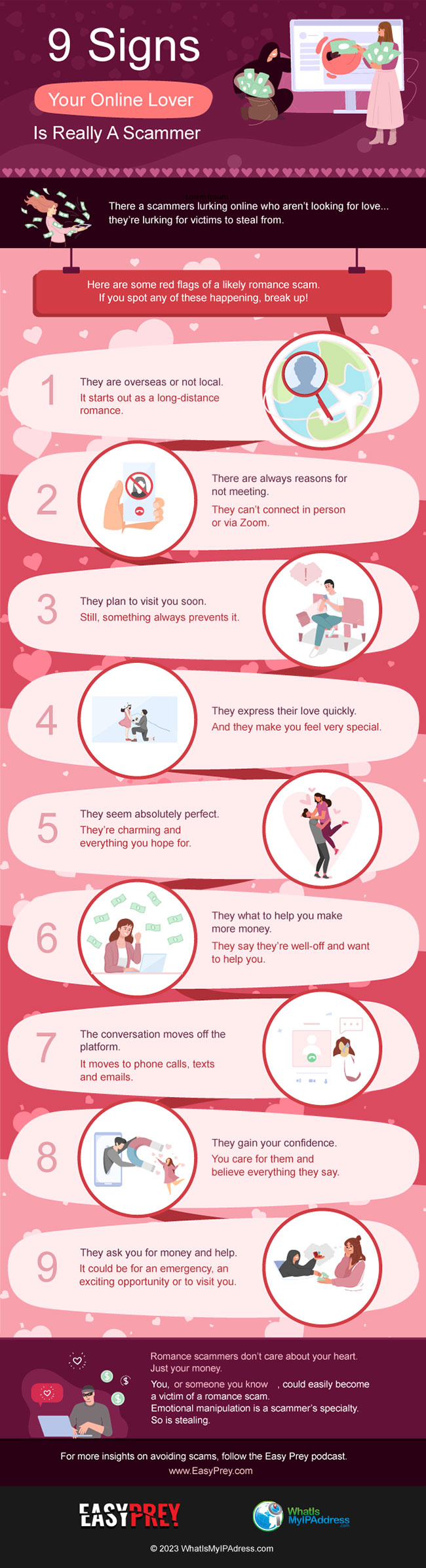
They are in love with your money…not you.
Online scams of any kind—job or investment scams—are bad enough, but romance scams are cruel. The thieves don’t care who they hurt, as long as they get an opportunity to steal their victim’s money.
The scam doesn’t even have to be on a dating app, like eHarmony, match.com, or Silver Singles. Fact is, a scammer can reach out to you on common platforms like Facebook, Instagram, and TikTok, start a conversation, and slowly earn your friendship and trust. Stories like those of Tinder Swindler victims highlight just how manipulative these scammers can be, often gaining their target’s trust and exploiting it for financial gain.
Without a concern for your emotions, a romance scammer will break your heart while they break your bank account. Some victims have given a scammer their entire life savings.
Romance scams are generally targeted toward those 60 years of age and older, but anyone who’s on a dating site or who may be in a vulnerable frame of mind cam become a victim.
Better safe than sad and broke.
Here are some habits and practices to learn if you’re new to online dating, haven’t given this topic much thought until now, or friends and family who might be ready to give it a try.
Do this for everyone one you begin a connection with online with, if you think you want to continue carrying on a conversation. Don’t trust people. Trust your instincts and do your homework.
- Set up a video chat like Zoom or Google Meet. A scammer will not be happy about that.
- Research the person. Start with a basic Google search.
- Go slow. Very slow. Consider someone a stranger for a long time.
- Don’t share too much information. A scammer will use it to profile you.
- Be careful with photos. Don’t send intimate pics of any kind.
Love means never having to say, “I’ll send you five grand.”
This advice isn’t just for you: It is also for the friends and family that you care about most, especially those who are looking for relationships online and who maybe be more susceptible to being deceived.
This also isn’t about avoiding online dating and relationships. These warnings are meant to help ensure you’re not one of the thousands of people that really do get scammed by people pretending to be good-hearted and a good catch.
If you want to be sure, there are services such as socialcatfish.com for people who think they are being catfished. The service can do some investigating and determine the validity of a person’s social media profiles.
Follow the Easy Prey podcast.
It’s never too late to learn, use and share good cybersecurity habits. Join the fight against romance scams and share this article and infographic with those you care about.
Chris Parker, CEO of WhatIsMyIpAddress.com, also hosts the Easy Prey podcast. He interviews guests on cybersecurity and scams, including romance scams. You can see a list of all episodes by searching for the Easy Prey podcast on your favorite podcast platform.
You can also see his podcast episodes by clicking the link below.
Get Involved in World Romance Scam Prevention Day
World Romance Scam Prevention Day, October 3rd, is organized by Bryan Denny and Kathy Waters of Advocating Against Romance Scammers. You can find ways to help prevent romance scams at protectingheartsday.com. The website provides ways you can get involved, examples of ways other communities are working towards romance scam prevention, and logos you can share to show your support.
On October 3rd, they are also offering a no-cost, no obligation webinar where you can learn more. Guest speakers will include a pig butchering survivor talking about their survivor story, a counselor talking about the emotional impact of manipulation in romance scams and how to recover, a representative from Match Group talking about the tech side of romance scams, and an FBI agent covering the reporting process and what you can expect when you report a scam. Register for the webinar at protectingheartsday.com/webinar.
Sources:
- Romance scammers’ favorite lies exposed | Federal Trade Commission (ftc.gov)
- IC3 2022 Annual Report
- Who experiences scams? A story for all ages | Federal Trade Commission (ftc.gov)
- Reports of romance scams hit record highs in 2021 | Federal Trade Commission (ftc.gov)
- Sextortion: It’s more common than you think | ICE
- 9 Shocking Online Dating Scam Statistics (Romance Scams Statistics) (dataprot.net)
- Fraud and cyber crime still vastly under-reported | Computer Weekly
Related Articles
- All
- Easy Prey Podcast
- General Tech Topics, News & Emerging Trends
- Home Computing to Boost Online Performance & Security
- IP Addresses
- Networking Basics: Learn How Networks Work
- Online Privacy Topics to Stay Safe in a Risky World
- Online Safety
- Uncategorized

Awareness and Safety Go Hand-in-Hand: Tips to Protect Yourself
Scams are often (though not always) technology-based, and physical danger happens in the physical world. But both…
[Read More]
We Created EasyPrey.com Scam Help Page to Help You
WhatIsMyIPAddress.com and our sister website, EasyPrey.com, focus on providing content and links to information and resources for...
[Read More]
EasyPrey.com Resources for Scam Victims
We’ve compiled a list of resources for all victims (and near victims) of scams, fraud, and identity…
[Read More]
The BBB Scam Resources Are There to Help You!
The Better Business Bureau is on YOUR side, helping consumers with real-time scam tracking, which you can...
[Read More]
Amazon Scams Come in All Shapes and Sizes. Are You Prepared?
Tell Amazon ASAP if you’re a victim of a delivery scam. Amazon takes fraud and scams quite...
[Read More]
How Companies are Collecting, Tracking, and Selling Your Personal Information
The modern world comes with many technological and digital conveniences. But unfortunately, many of them come with…
[Read More]