
Signs Your Phone Has Been Hacked: How to Tell and Protect

What are the signs your phone has been hacked? And what to do if I am being hacked?
Near the city of Olympia, Washington, in October 2016, people in the region were calling 911 and hanging up before operators could answer the call. Then, the same phone would call 911 again. Over and over. Finally, an operator was able to answer one of the person’s calling in. “Don’t hang up!” she told the caller.
The teenage girl on the line said, “We didn’t mean to call 911! I’m not touching the phone. I’m not doing anything…and I don’t know how to make it stop!”
Her iPhone, and thousands of other smartphones, had been taken over with malware that started off as a bad prank initiated by a young college student in the area. He and a friend had “discovered a loophole in iPhone software” and designed a program to exploit it. The web link that took over the smartphone was clicked on almost 120,000 times…and each click generated dozens of fake emergency calls.
The attack spread to dozens of emergency call cents around the country, because wherever the person lived when they clicked on the link, it generated 911 calls to the closest center.

Cyberattack on smartphones.
Here is the issue. Your smartphone is essentially a phone plus a “web enabled computer”—That puts it at risk to be infected with malicious software (malware) just like a laptop computer. And that malware is created by a hacker, but is downloaded on smartphones by unsuspecting victims like you.
The hackers don’t steal your phone and physically downloaded malware—they don’t need to.
Instead, they have planted viruses on websites designed to infect smartphones. Then they get people to click on a link from their phones, which takes them to the website and the malware link. It’s as simple as that.
That’s what caused all the smartphones to start calling 911. Ordinary people simply clicked, without much thought or worry, on a link on someone’s Twitter feed, just like they do every day. But that click took them to the website that took over their phone. (The victims needed to turn off their phones to make the calls stop.)
Here are ways your phone can be hacked.
Your smartphone may have been hacked if you notice apps opening by themselves or if the battery drains much faster than normal. Here are ways that a hacker might try to trick you into giving up control of your smartphone:
Through messages from a hacked phone.
- If you receive a text message from someone you know that starts off with strange characters or even odd shapes (squares, for example), it is most likely a text from a hacker who is hoping you’ll open it and read the message.
- If you open the message, you will download spyware or malware on your phone. It’s that simple with smartphones—and hackers know it.
- How did the hacker get your number? They probably first hacked the phone of a friend and are now exploiting their list of contacts. The hacker is using simple tricks to spread the virus from phone to phone.
Through unauthorized use of your phone…remotely.
- Skilled hackers can take over a hacked smartphone and do everything from making overseas phone calls, sending texts, and using your phone’s browser to shop on the Internet. They may even use a phone to create a phone burner number for temporary or fraudulent activities. Since they’re not paying your smartphone bill, they don’t care about exceeding your data limits.
- Do a phone check: You know your phone better than anyone else, so go through your pictures and texts and see if anything looks out of the ordinary. You’ll find out fast if someone else has been clicking your camera from a remote location.
- Check your wireless account. If something seems out of the ordinary, check with your smartphone service provider. If your monthly bill and data usage tend to be the same each month, they’ll be able to recognize irregularities on your account. Be sure to go back a few months.
Service Disruptions.
- If you are experiencing ticking sounds or other noises during calls, it could be a sign someone is attempting to access your phone. Abruptly dropped calls aren’t always the fault of your service provider…it could be an active hacking attempt.
- If your service provider cannot provide an explanation as to why your phone is not working the way it normally does, it might point to a hacking attempt.
Take your phone in for a checkup.
If you think you might have malware on your smart phone, take it into a phone store for a complete diagnostic test. They should be able to detect and eliminate any malware installed on the phone.
Making Phones Hack-Proof for Seniors, Friends and Family.
A new infographic illustrates how we can help others by making phones hack-proof for those we care about.
One of the things cyberthieves count on and look for are potential victims who are unaware of what they can do to stay safe and be less vulnerable. Many scammers prey on those over 60 years of age for precisely that reason. Learn also facts about SIM jacking as it could help.
Statistics show, sadly, that the older crowd loses more money annually to phone-based scams than other age groups.
Is there any way to help change this fact? There is.
What if that targeted group, with the help of people who cared, was 1) made aware of some common dangers and 2) also learned how to boost their defenses? Most likely, the scammers would not have it so easy in those cases. This new infographic below—exclusive to WhatIsMyIPAddress.com—is a perfect example of that: People helping others stay safe.
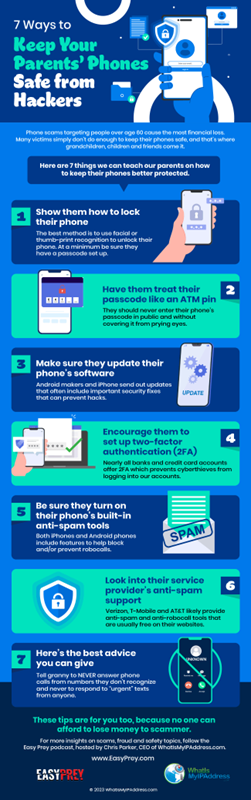
Scammers work together: So why don’t all of do our part to prevent scams.
Cyberthieves often target people over the age of 60, assuming that audience can be fooled or bullied into giving up their money or information. Scammers just assume grandparents have low cyber-awareness and that makes them easy prey.
And although that may be the case, it doesn’t have to stay that way and remain a given!
Family by family or friend by friend, ordinary people can join in the fight against cybercrime without having to invent an app.
It can start with you! All you, and others like you, need to do is share what you all know with others about being cyber-savvy and prepared. If everyone picked just one friend or family member to help, imagine the changes we could make.
Beyond making phones hack-proof, other ways to help others avoid scams.
- Identify some people you care about that you fear might be an easy target for a scam.
- Ask them, in person if you can, basic questions to find out if they have an awareness of common scams.
- Use the points in the infographic above to see if they have the essentials of phone safety covered.
- Be willing to invest time with one or two people to personally help them boost their individual cyber security.
- You might consider telling those you contact to reach out to you anytime they have a question or concern about a phone call, a text or strange email they received.
The Easy Prey podcast.
On the website EasyPrey.com, you can not only read helpful articles on how to avoid scams and fraud, but you can also see a list of episodes on similar, vital topics. The podcast was created and is hosted by Chris Parker, CEO of WhatIsMyIPAddress.com.
Here are a couple of examples of Easy Prey podcast episodes on the topic of taking care of those we care about:
- How to Spot Fake Dating Sites. If you know someone who is looking for love online, you (and they) should know of the dangers online and the reality of fraudsters looking for money, not love.
- How to Prevent Financial Exploitation. Seniors are not only targets for phone scams, but they are also easy prey for all types of criminality, offline and online. This podcast is a must for adult children of aging parents.
There’s some good news in the fight against cybercrime.
But first the bad news, or at least the reality, and it’s simply this—scams (fraud attempts) and scammers (the people running scams) will always be with us.
More than that, fraudsters are relentless with attacks and are always on the prowl to find easy prey. They adopt new technologies; they are opportunistic and react to what is going on in the world that cause people to become fearful…or greedy. Finally, they are working in concert with other scammers to create what has become a scam network, globally.
Scammers are no longer a few swindlers working a neighborhood or a convention who are looking for victims on a one-by-one basis. They have expanded.
Now the good news regarding the fight against scams: It’s not all bad news, and here’s why.
- There are products, programs, organizations and resources that provide solutions and help so we can attempt to stay as safe as we can. For example, read our article about the free Security Planner offered by Consumer Reports.
- Organizations and even government sectors now realize they need to drastically up their game against scammers and hackers. They see they not only need to protect their own interests, but also to better protect consumers…their customers.
- Consumers around the world are raising their voices louder and saying “ENOUGH!” They too are holding business and government agencies more accountable.
- Lastly, cybersecurity experts are getting an important message out to us. We must recognize our personal role in staying safe. Regardless of new laws and regulations, when it comes to cybersecurity, we have to play a bigger role in taking care of ourselves and those we care about.
Your friends and family need help making phones hack-proof!
People are realizing that good defense starts at home. That’s why adult children are actively helping their aging parents and grandparents become better protected against scammers. It’s also why schools, parent organizations and cyber experts are raising the awareness of cybercrimes against children of all ages. You can read about one cybersecurity expert’s story and efforts here on our website.
Keeping those we care about safer online starts by caring enough to help. Making phones hack-proof is just one place to start! If you want to learn more about cybersafety, follow the content on WhatIsMyIPAddress.com.