
Fake Websites, Fake Videos, and Fake Messages are Faking Everyone Out
If someone tells you to beware of “fake websites,” your first reaction might be to think or say, “Why would I ever go to or even wind up on a website that wasn’t the genuine thing? I’m too smart for that.” And you’re mostly right, in the same way that you most likely don’t buy fake, knock-off merchandise or deal with fake companies selling fraudulent merchandise.
That is, at least not intentionally. And that’s the point.
Most people think they’re savvy enough to avoid fake websites, people, or merchandise that aren’t the real thing. But that isn’t the case. Not by a long shot.
When people are fooled or even scammed by fraudsters, they’re not even aware of what’s going on or what they’re doing until it’s too late.
That goes for anyone, regardless of age, intelligence, education, or experience.
You’ve heard this saying before, and we all need to hear it again—you can’t believe everything you see or hear. And if there’s ever been a time to be skeptical, slow to trust, and slow to respond or react, that time is now.
Here’s what’s been taking place lately as far as fake websites and more.
The term for this trend of tricking consumers into visiting fake websites is website spoofing. They’re not necessarily imitating other websites’ primary home pages. Instead, they create webpages/websites that seem to be associated with a company or organization.
For instance, you might first get an email or text saying there’s an issue with your account. If you respond and click a link, you’ll be directed to a webpage to address the issue. That website is fake, and you’ll be providing information directly to cyber criminals.

Here’s an example of a fake website that unsuspecting consumers flocked to.
It doesn’t start with fake websites or emails…it ends there.
One reason people drivers get lost or end up in the wrong place is that they receive misleading or incorrect directions. It’s the same with ending up on a fake website (you don’t know it). You didn’t intend to be there, but you unknowingly followed bad directions. You see, to get you to a fake website, a scammer must lure you there. And the message (and the delivery)—a text, an email, or even a pop-up on a website—has to be pretty convincing.
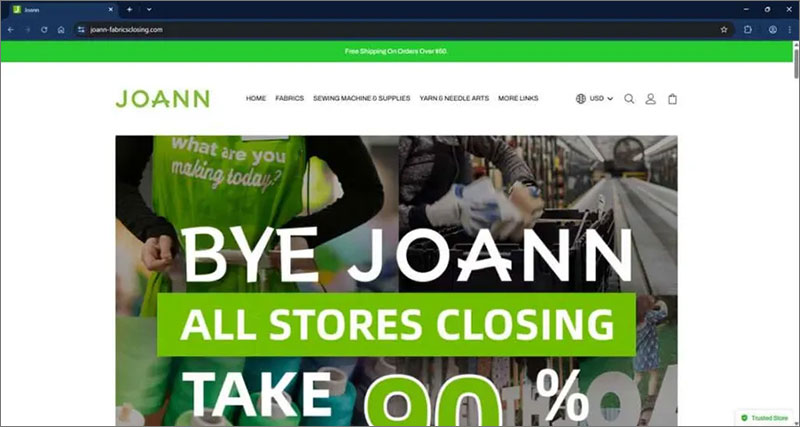
Websites imitating Joann Fabrics were common in early 2025.
When the very popular fabric store Joann Fabrics closed last year, several websites popped up immediately, claiming to be affiliated with Joann’s and offering closeout sales and discounts. The websites looked precisely like the Joann brand and used product images and style from the Joann official website. But the scammers running those websites had nothing to do with Joann’s. Their goal was to lure customers seeking deals, then steal their credit card information and other personal data.
The URLs had names like “joannlosngeles.com” or “joanndiscount.shop.” All legitimate-sounding but fake businesses run by crooks. This type of website spoofing occurs every day across all industries.
There’s a time and place for fake websites.
According to statistics, spoofed websites and the fraud they enable have racked up nearly $270 million in losses for United States consumers. It can happen any time of year, of course, but it might be more prevalent in specific periods or seasons.
- Prime Day Surge: Prime Day is an exclusive shopping event for Amazon Prime members in July. Scammers were ready and generated fake Amazon websites to fool shoppers.
- Black Friday/holiday shopping season. Holiday shopping starts early in the U.S. in November, and fraudsters have their phishing campaigns ready to lure shoppers to fake sales on fake websites.
- Tax-filing season: Tax scams pop up every year, especially as the filing deadline approaches.
A well-orchestrated fraud campaign.
The problem isn’t simply fake websites or fake emails anymore. With the widespread use of Artificial Intelligence, hacks, scams, and cybercrime have become a business for fraudsters as never before.
- AI makes it easy to be fooled at a glance or even on closer inspection. In the hands of criminals, AI helps create websites that look exactly like the brands or organizations they’re imitating. The text can now be mistake-free, and the photos can be copies or duplicates of the real ones. You’ll think you’re in the right place.
- Technical sophistication: Beyond just the look, fraudsters use programming and technology to trick you into entering login credentials, including passwords.
- Leveraging your busy lifestyle and reliance on your phone. Certain age groups function primarily from their phones, so con artists use fake apps and text lures, called SMS phishing, to fool users on the fly.
.
Who is getting spoofed with fake websites and more?
The question really should be: which industry or organization isn’t being imitated by scammers and cybercrime enterprises? These days, plenty of organizations across industries seem to be fair game.
Remember, it’s not really the companies or organizations that are targeted in Website spoofing; it’s consumers and perhaps regular customers of those organizations who are the real targets. Scammers want to trick them into believing that Google, Microsoft, or Joann Fabrics has news for them.
- Technology: Scammers used fake emails and websites to spoof Microsoft, Google, Apple, and Adobe. The fraud often began with account breach alerts.
- Retail marketplaces: Fraudsters leveraged the names of Amazon, Booking.com, and online marketplaces to create fake sites and steal payment information.
- Government or utility services: According to statistics, scams that mimicked toll-road sites to collect fake unpaid fees and steal credit card data skyrocketed by nearly 900% in 2025.
- Social media and apps: AI-generated ads or messages on Facebook, WhatsApp, and LinkedIn, when clicked, directed consumers to fake websites where a range of fraud took place, including investment scams.
How to be extra careful and thoughtful in the world of fake communications.
As we’ve mentioned, today’s fraudulent websites, emails, and messages, created by teams of cybercriminals using Artificial Intelligence, fool millions of people every year, and the problem will only continue to grow. Part of staying safe online includes having a strategy in place:
- Being more aware of scams and fraud. One thing you can do is follow the Easy Prey podcast, hosted by Chris Parker, CEO of WhatIsMyIPAddress.com.
- Developing new habits for the cyber age. You simply cannot believe everything you read, see, or hear. That’s why many people don’t answer texts or phone calls from numbers or names they don’t recognize. New rules and habits go a long way toward keeping you safe.
- Not instantly panicking (and responding) to urgent, “emergency” or problem messages. Scammers get through our defenses by knocking us off our game and manipulating our natural, emotional responses.
- Don’t click on links in emails or texts unless you trust the sender. If the email or text seems out of the ordinary, do some investigating.
Stay alert and stay informed about privacy and security issues.
That expression, “if it ain’t broke, why fix it?” applies to scammers and cybercriminals. Attackers in 2025 used Website spoofing, powered heavily by AI, to steal credentials and money and to run extortion campaigns. And though they’ll likely continue to refine and improve their efforts, they get even more comfortable with and emboldened by AI.
For more information on how AI is changing the world of scams, and how manage your online experience to avoid scams and other issues, visit our Learning Center and explore articles and interviews on the topic.
Related Articles
- All
- Easy Prey Podcast
- General Tech Topics, News & Emerging Trends
- Home Computing to Boost Online Performance & Security
- IP Addresses
- Networking Basics: Learn How Networks Work
- Online Privacy Topics to Stay Safe in a Risky World
- Online Safety
- Uncategorized
A Former Fraudster’s Tips for Protecting Your Personal Information in a Connected World
Technology is evolving so fast and is ever increasingly integrated into our world. It’s becoming less and…
[Read More]
Awareness and Safety Go Hand-in-Hand: Tips to Protect Yourself
Scams are often (though not always) technology-based, and physical danger happens in the physical world. But both…
[Read More]
We Created EasyPrey.com Scam Help Page to Help You
WhatIsMyIPAddress.com and our sister website, EasyPrey.com, focus on providing content and links to information and resources for...
[Read More]
EasyPrey.com Resources for Scam Victims
We’ve compiled a list of resources for all victims (and near victims) of scams, fraud, and identity…
[Read More]
The BBB Scam Resources Are There to Help You!
The Better Business Bureau is on YOUR side, helping consumers with real-time scam tracking, which you can...
[Read More]
Amazon Scams Come in All Shapes and Sizes. Are You Prepared?
Tell Amazon ASAP if you’re a victim of a delivery scam. Amazon takes fraud and scams quite...
[Read More]