
The Psychology of Influence: Why Saying No is So Hard
Most of us believe that we’d be able to spot a scam and walk away from it. But it turns out that in the moment, knowing something is a little fishy doesn’t stop us from going along with it anyway. That’s because our brains are wired to trust others, cooperate, and avoid conflict. This leaves us more vulnerable than we’d like to think. Understanding the psychology of influence can help explain why saying no is so difficult and give you tools to protect from manipulation.
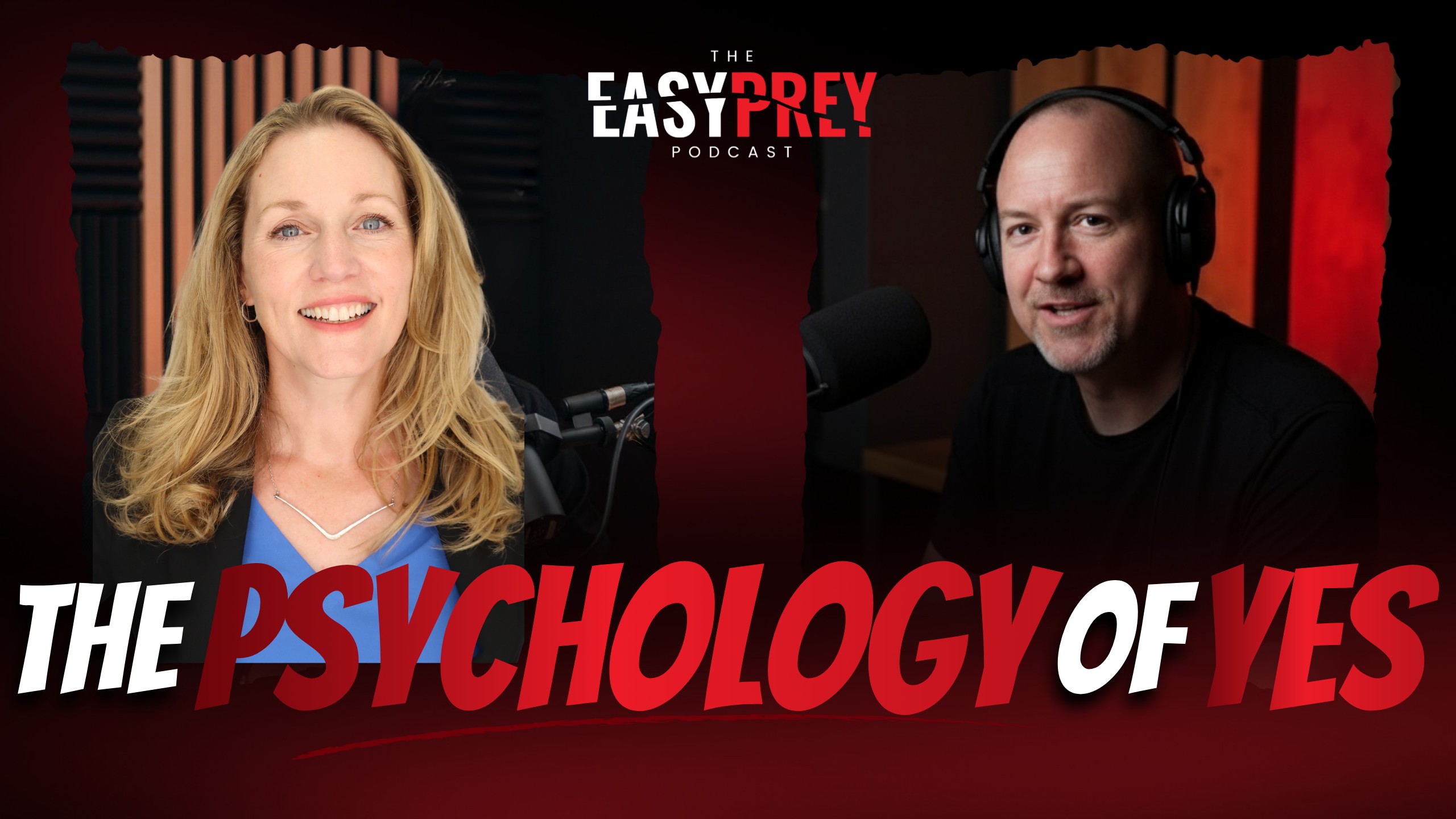
See The Psychology of Yes with Vanessa Bohns for a complete transcript of the Easy Prey podcast episode.
Vanessa Bohns is an experimental social psychologist, professor, and Chair of Organizational Behavior at Cornell University. Her research area is social influence and compliance, especially focusing on how simple tactics can be incredibly effective. People can do surprising things just because someone asked them to do them. And that puts people at risk. We tend to be confident about our abilities to not fall for influence tactics, but when saying no or pushing back would be impolite or we think it would make someone not like us, we all tend to choose to be polite and likeable.
We could be surprised by things that people have agreed to do just because they were asked … which of course can open us up to all sorts of nefarious actors.
Vanessa Bohns
Researching the Psychology of Influence
Vanessa started her career in advertising and marketing, and in her PhD studies, she was just looking at ordinary influence and persuasion. But she found early on that phrasing didn’t matter all that much. People tended to comply with simple, ordinary requests. The medium – whether it was in-person, over the phone, via email, etc. – made a much bigger difference. She concluded it was much harder to say no than most people expected. And it wasn’t just marketing. People also found it hard to say no to unethical or intrusive requests.
From the very beginning, Vanessa started every study thinking there was no way it would work. And every time she was blown away with how willing people are to do things. She started with bringing in participants and asking them to ask other people for small favors, like filling out a survey or borrowing their phone to make a call. Each time she asked participants beforehand how many people they’d have to ask to get five yesses, then sent them out to ask. And others were about twice as likely to agree as people thought they would be.
Then she started coming up with more questionable things for participants to ask for. They would ask people to tell a lie on the participant’s behalf or sign a document saying they’d done something they hadn’t. The rate of agreement still held. One experiment had participants asking strangers to vandalize a library book. The participants tracked what people said, and while many of them said things like, “We shouldn’t do this,” and “That’s vandalism,” 60% of them still did it. It was more uncomfortable for them to say no to this person’s face than to do something they thought was wrong.
Underestimating the Psychology of Influence
In these experiments, Vanessa thinks the participants didn’t understand the depth of the psychology of influence. They underestimated their ability to persuade people and overestimated other people’s ability to say no. People in general tend to underestimate their own power to get other people to do something, including unethical things. Many of the participants came back surprised at their own influence.
At the same time, if you ask people in the hypothetical what they’d do in that kind of situation, they’d say they would refuse. Vanessa gets angry emails all the time complaining that there’s something wrong with the participants in her studies, because obviously good and moral people would never do something like that. But in the moment, awkwardness and the fear can have a huge influence on behavior.
In the heat of the moment when you’re face-to-face with someone, awkwardness is such a powerful driver of behavior.
Vanessa Bohns
There’s a phenomenon called the “illusion of courage.” We all imagine that if we’d stand up to someone asking for something unethical or point out something we think is wrong. But when it happens, we might offend someone or come across as unlikeable. The same people who say they would have acted tend to keep quiet and not rock the boat.
Why it’s So Hard to Say No
There are a lot of reasons why people tend to go along with things and find it difficult to say no to others. We generally think that other people are more disagreeable than they are. We think their default response is to say no to us and go against what we have to say. But humans are wired to cooperate and get along to stay part of the group. Being excluded from the group meant almost certain death, so we want to avoid it. If someone is asking for something, saying no is a rejection, which might mean they don’t like us or get angry at us or might affect our reputation. That feels risky.
We are evolutionarily wired to cooperate to not be rejected from the pack. When someone is asking us for something, to say no is essentially rejecting them.
Vanessa Bohns
In the immediate moment, when we’re right in front of someone, we forget how much that affects us. But at an evolutionary level, we’re wired to avoid rocking the boat and keep our relationships smooth. Just the idea of pushing back or saying no can make us feel incredibly awkward and embarrassed. The psychology of influence capitalizes on those feelings. Ultimately, they make us just agree and go along.
This means that the medium of the request makes a difference, too. The biggest effect is in person. It’s extremely hard to say no to someone who’s standing right in front of you. This makes sense. We evolved interacting with people face-to-face. Email is the least effective. It lacks social cues and it’s asynchronous. You don’t have to respond right away and you can even ignore an email. Phishing emails have gotten better, and Vanessa has fallen for them, but it’s the least effective.
Our Brains are Wired to Help Scammers
We tend to judge others for getting caught in scams that also would have caught us. And there’s a lot of things behind that. One of them is hindsight bias. Once we know how everything turned out, it’s easy to look at the facts and assume the ending we know was obvious from the beginning. If you know the ending of the Tinder Swindler’s story, it’s easy to wonder how people fell for such ridiculous stories. But we’re wired to trust people and give the benefit of the doubt. Even if things feel a little odd, we don’t jump to assuming they’re scamming you. That’s just not realistic.

If you assumed everyone was lying to you all the time, you’d never be able to communicate. You have to assume that people are telling the truth. It’s the only way to function in the world. And most of the time, you’re correct. Unfortunately, scammers take advantage of that. They leverage the psychology of influence and the fact that we assume people are trustworthy.
If someone says something a little odd, we don’t assume it’s a red flag. We give the benefit of the doubt. It’s only when the scam is revealed that we can see how it all fits together. And we’re generally not looking for things that don’t fit the story, either. Our brains want to trust, so we help the person tell the story they’re trying to tell.
In the moment, most of us will just kind of go along to get along. It’s only after the fact, looking at this in retrospect … that we see how the pieces came together.
Vanessa Bohns
The Psychological Tactics of Social Engineering
Kevin Mitnick, a famous hacker, did a lot of social engineering. He used his knowledge of influence and psychology to get data and passwords not just from hacking computers, but hacking people. He would give out just enough information to make his story plausible, sticking to little pieces of information that he couldn’t be challenged on.
One tactic he used was calling around a company until he got someone’s out-of-office voicemail message. Then he’d call their secretary and say he didn’t realize that person had left already but maybe the secretary could help. Just that little bit of information gave him a bit of trust and authority. The secretary assumed it was someone who knew their boss and whom their boss was expecting to hear from. If he had just called out of the blue, the secretary might have been suspicious. But just that little bit of info was enough to make people assume he was legitimate. And in the end, most people want to believe that the people they’re talking to are genuine.
In the end, I want to believe that if someone’s asking me for something, I’m not getting scammed.
Vanessa Bohns
Mitnick didn’t use elaborate stories. It’s easy to get lost in the weeds and give too much backstory. The average person thinking about convincing someone tends to come up with an elaborate explanation. But the psychology of influence shows that you don’t need that. Just simple, tiny cues that you’re trustworthy or have some authority is plenty.
How to Say No
It’s incredibly hard to resist the psychology of influence in the moment. That’s why the key is creating distance. Saying no in the moment is hard. We don’t want to offend the other person by asking if they’re really who they say they are or make them angry by saying no. So as much as you can, get distance. You can even make up an excuse, like saying you’re in the middle of something but you’ll call back. Another helpful thing is to point to something outside of yourself to blame. If you can say you have to check with someone else – your boss, a company policy, the joint owner of the bank account, whoever – it’s easier. People are often more comfortable using external excuses.
One of Vanessa’s current experiments brings participants in, and one of the researchers in ordinary clothes asks them to unlock their phone so the researchers can look through it. This is a very intrusive request, and if you ask people in the abstract if they would agree, three-quarters say they wouldn’t. But even though participants were clearly uncomfortable, 97% of them unlocked their phones and handed them over. In a similar experiment, Vanessa did the same thing, except she told people a day in advance that they were going to be asked to hand over their phones. With that time, people were less likely to do it. Our default is to agree. But when we have some distance, we can think about it and make a more conscious choice.
Our default is to go along, to agree. When we’re in the default of the moment, we just do it.
Vanessa Bohns
Making “No” Easier
It’s all well and good to know not making an immediate decision is good. But doing it in the moment can be tricky. Vanessa recommends setting yourself a rule that you don’t make a decision in the moment, and that you don’t break that rule under any circumstances. This can help you feel less awkward about saying no. Your refusal isn’t about you being rude or not being helpful, you’re just following the rule. As a bonus, this tip is helpful for salespeople and scammers alike. It works against both pushy car salesman and fake Amazon representatives on the phone.
In-person, phone, and video conversations tend to be more persuasive. When someone messages you trying to get you to jump on a video call to discuss something, they’re using psychology of influence to try to get you to agree to something. You can push back on that to give you more distance, too. Suggest you’d rather work it out over email first. Or you can even say you’d like some time to think before the call so you can be prepared and ask them to tell you what they want beforehand. This is a good principle to follow because it will help you make better decisions.
On the flip side, if you’re the one asking, you can make an effort to be a responsible asker. Let people know in advance what you plan to ask them and give them time to think about it. Just about everyone will appreciate this.
Incentives Make a Difference
People showing up in Vanessa’s lab to take part in these experiments showed up even though they knew they were going to be asked to unlock their phones because they had an incentive. Sometimes we will throw away the rules if it benefits us. On of Kevin Mitnik’s tactics was to tell people they were going to be shut out of their emails or files. The incentive of not losing access to that was high enough that they were willing to break the rules. They knew they weren’t supposed to be doing that, but the incentive was so high in the moment that they did it anyway.
One of the most interesting things about incentives, though, is that you don’t necessarily need them. They can be important and be a big part of the psychology of influence. But even when there’s no external incentive, there are interpersonal incentives. Not offending the other person, not being a jerk, and not being seen as a jerk in the social context are the incentive.
Even when there’s no incentives, the incentive is not to offend the person who’s asking you. … That is enough.
Vanessa Bohns
There is a threshold where incentives have a major impact on the results. But that threshold is a lot higher than you might expect. Some of Vanessa’s experiments around asking for small favors have varied how hard the survey is and if there’s a monetary incentive for doing it. But the incentive of an easy survey or money had almost no effect. This finding was part of Vanessa’s first book, You Have More Influence Than You Think. Incentive matters, but it’s not all about incentive – the psychology of influence is also a lot about relationships and social interaction.
Marketing Techniques and Scam Tactics
One of the things that makes spotting scams so difficult is it isn’t just scammers using the psychology of influence. Authority, urgency, and scarcity are common scammer tactics, but they also show up in just about every commercial you’ve ever seen. It’s hard to spot the line between someone who just wants you to buy their product and someone who wants to defraud you.
We all tend to be overconfident about our ability to handle situations. When we’re just thinking about it, the right course of action seems obvious. But when we’re in that situation, it’s much harder. The more we can slow down and give ourselves space to think, the better we will be able to protect ourselves.
It’s also essential to not judge others (or ourselves) too harshly when we do fall prey to the psychology of influence. Yes, we should all take every precaution we can and try to avoid it. But that doesn’t make anybody influence-proof. Prevention is important, but so is grace if or when it does happen.
Vanessa Bohns’ book You Have More Influence Than You Think talks about a lot of these issues. Her second book, Should I Say Something, releases in October and focuses on using influence responsibly. Get the books wherever books are sold. Find Vanessa online at vanessabohns.com, or on LinkedIn, Instagram, Bluesky, or Twitter/X @profbohns.