
Is Temu Safe & Legit?

Let’s say you’re scrolling on social media and you see an ad for a product you would love to have. Maybe it’s a sweater or a pair of shoes, perhaps a household item, or even something you need for work. The item itself looks great, but when you take a look at that price, it’s even more exciting–could that deal possibly be legit?
This is how many Temu shoppers first encounter the platform. Others find it because of recommendations from friends and family, or affiliate marketing platforms on TikTok and Instagram.
Savvy online shoppers don’t just buy anything that looks like a great deal, though! And it makes sense that people are skeptical of Temu. If a deal seems like it may be too good to be true, it’s worth slowing down and doing some additional research.
So what is the truth about Temu? Is it legitimate? Are there high-quality items sold on Temu? Or is skepticism warranted? The answer is a little bit complicated!
What’s the story with Temu?
Temu (pronounced “teh-moo”) was launched in the US in 2022 and quickly became the most downloaded shopping app in the country. It has outcompeted Amazon, Shein, and countless other mobile apps in popularity.
Discounted consumer goods, including clothing, footwear, household goods, jewelry, pet supplies, toys, electronics, and automotive accessories, are sold at discounted rates through the Temu app.
Temu is a multi-national organization, with its parent group, PDD Holdings, headquartered in China. Although many people get great deals and are satisfied with the products they buy from Temu, the company has been plagued with criticism, including:
- Extremely cheap, low-quality products
- Misleading, AI-generated images of products
- Data privacy concerns
- Accusations of forced labor
- Intellectual property theft
It’s also difficult to trust video reviews of Temu from influencers large or small, because Temu has a history of paying influencers in cash or in-app credit to promote their platform. Disclosure of these agreements is a legal requirement in the US, but that doesn’t mean that everyone is following the law. Check out this user talking about the offers he has received from Temu to make content saying that the site is safe and reliable! (Skip to 1:50 to hear about the offers.)
Consumers need to understand the risks and payoffs of ordering from Temu and similar platforms. After all, you can only make a truly informed decision if you understand the full picture of what it means to use the app.

Is Temu safe?
Before you consider the ethical implications of using Temu and similar apps, it’s important to consider whether or not your personal and data security is jeopardized while using the app.
First of all, Temu itself is not a scam site, in the sense that it is a real platform that sells real products to real consumers. According to Temu’s own stats, they process 1.6 million packages every day. Most shoppers will get their packages, although there may be delays or questions about the quality of the products.
But what about data security? Is it safe to order products on Temu with your credit card or debit card? What happens to the data the site collects about you as a consumer?
Understanding Temu’s privacy policies
Temu’s privacy policies are spelled out on their website. Here’s what you need to know:
Temu collects extensive personal information from multiple sources—including data you provide directly (name, address, payment details, purchase history), information gathered automatically through cookies and tracking technologies (browsing behavior, purchase patterns), and data obtained from third parties like delivery partners. They use this information for order processing, customer service, personalized product recommendations, and fraud prevention. While they explicitly state they don’t sell customer data, they do share it with third-party service providers who handle functions like order fulfillment and package delivery, though supposedly under strict privacy agreements.
Their security claims include:
- Encryption
- PCI DSS compliance for credit card data
- Partnerships with cybersecurity firms like HackerOne through their vulnerability response program
However, the Privacy Notice follows a familiar pattern of broad data collection justified by service improvement, with the standard legal disclaimers about releasing personal information when they deem it necessary to comply with laws or protect their interests. Users can access account information and opt out of marketing communications, but the notice reserves Temu’s right to modify these policies at any time, with continued use of their services constituting acceptance of whatever changes they decide to implement.
Known risks to your privacy from Temu
In early December 2025, Arizona’s Attorney General Kris Mayes filed a lawsuit against Temu for “unlawful data collection, violations of customers’ privacy, and counterfeiting some of Arizona’s most iconic brands.” This is not the first lawsuit of its kind. Kentucky and Nebraska have filed similar suits.
Fortune magazine explains:
“Mayes said the app deceives customers about the quality of its low-cost products and collects what she described as a shocking amount of sensitive data without the consent of users, including GPS locations and a list of other apps on users’ phones. According to the lawsuit, prosecutors are concerned about Temu being subject to laws in China that require Chinese companies to hand over data requested by the government, and that its code is designed to evade security reviews.”
Was there a Temu data breach in 2025?
In September 2024, a hacker claimed they’d stolen personal information from 87 million Temu users and posted sample data as proof. The leaked information supposedly included names, birthdays, phone numbers, addresses, and encrypted passwords. These are exactly the kind of details scammers love for identity theft and phishing schemes.
Temu investigated and said no breach actually happened. They checked the sample data against their own records and found no matches. Cybersecurity researchers backed this up, tracing the supposed “Temu data” back to a completely different company’s breach from 2021. The hacker was eventually banned from the dark web forum for trying to pass off old, recycled data as a fresh leak.
Even though the breach turned out to be fake, security experts still have concerns about Temu.

Are Temu products high-quality?
The best word to describe Temu’s product quality is “inconsistent.”
Some shoppers have been highly satisfied with their purchases, but the complaints are plentiful. Trustpilot’s system ranks Temu as a 2.1 out of 5 for customer satisfaction, with the majority of buyers reviewing the site as a 1 out of 5.
Take a look at these recent Trustpilot reviews to get an idea of how people feel about their Temu purchases:
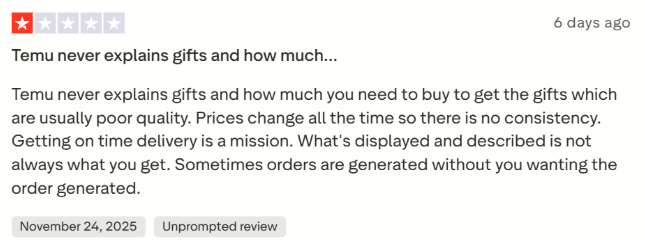
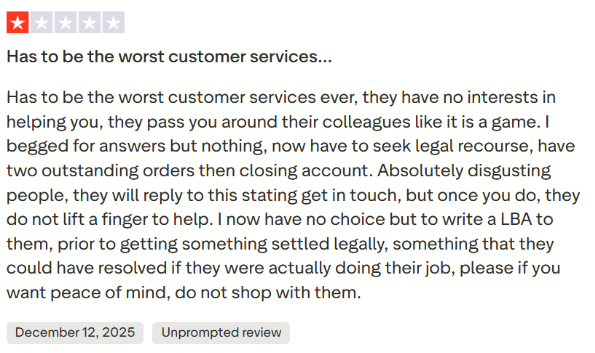
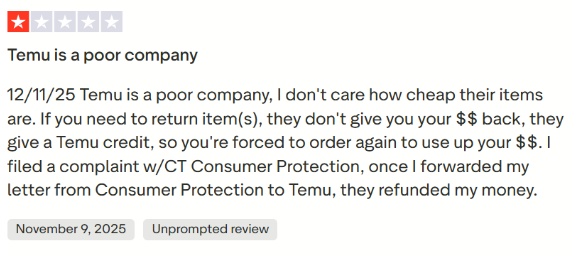
There are some positive reviews, too, of course! 28% of Trustpilot’s reviews for Temu are 5-star, compared to 53% of users who gave a 1-star review. People with positive experiences typically cite low prices, accurate product descriptions, and detailed tracking information during the shipping process.
If you want a good laugh, check out this complication of “Temu fails” that shoppers have posted online!
Protections for Temu shoppers
Temu offers guaranteed returns and exchanges for their products, especially if it turns out that the product does not match the description.
Temu offers a 90-day return window for most items, with free return shipping on your first return from each order. You can request returns through your account, and they’ll provide a prepaid return label for USPS or UPS. The process is straightforward: select the items you want to return, choose whether you want a refund to your original payment method or Temu store credit, print the label, and ship it back within 14 days of submitting your return request.
These are the most important things to know about Temu’s return policies:
- Free returns have limits. Only your first return per order is free. If you need to make a second return from the same order, you’ll pay $7.99 plus tax in shipping fees deducted from your refund.
- 90-day window with exceptions. Most items can be returned within 90 days, but electronics may have shorter windows (45-60 days), and some items can’t be returned at all: worn or washed clothing, food products, certain health/personal care items, customized products, and some underwear.
- Quality inspection matters. Your refund isn’t guaranteed until the warehouse receives your items and they pass inspection. If items are used, damaged, or missing parts/accessories (and it’s not Temu’s fault), your refund will be reduced.
- Different refund speeds. Depending on your shopping history, you might get an “instant refund” before shipping, an “advanced refund” after dropping off the package, or a standard refund after inspection. Refunds to your original payment method take 5-14 business days (sometimes up to 30 days), while Temu credits are faster.
- Keep those barcodes. Items need their original barcodes attached for returns. If you’ve lost them, you’ll need to package items individually in clear bags, which complicates the process.
Is using Temu ethical?
Solene Rauturier of Good On You wrote an article in 2024 about the ethical implications of shopping at Temu.
She explains that Temu’s biggest problem is that it hides everything about how it operates. The company won’t say how its products are made, who makes them, or what conditions they work in. This secrecy makes it impossible to know if workers are paid fairly or treated well. When Temu sells t-shirts for $5, those prices are too low to pay workers enough money to live on.
The mistreatment of workers is a serious concern. Government investigators discovered that Temu doesn’t check its suppliers to make sure they’re not using forced labor. The company might be getting products from a region in China where people are forced to work against their will. Temu says it doesn’t allow forced labor, but it won’t explain how it stops this from happening with its thousands of suppliers.
The harm to the environment is just as bad. Temu and similar companies ship about 600,000 packages to the US every single day, creating huge amounts of pollution. The company encourages people to buy too much stuff through endless sales, reward programs, and shopping games that work like gambling apps. Their only environmental effort is letting customers choose to plant a tree when they check out—a small gesture that doesn’t make up for all the damage.
Temu, according to Rauturier and other critics:
- Hides information about workers and factories
- Prices are too low to pay workers fairly
- No checks to prevent forced labor
- May use factories where people are forced to work
- Ships hundreds of thousands of packages daily
- Uses tricks to make people shop compulsively
- No real environmental protection
- No animal protection policies
- Avoids government oversight through loopholes
Ultimately, ethics are subjective, and each individual shopper must decide for themselves what they are comfortable with.
What’s the verdict? Should you shop at Temu?
Ordering from Temu comes with risks. Some deal-seekers will decide the risks are worth it, while others will pass on the low prices that the app offers.
From a privacy and data protection standpoint, ordering from internationally owned apps like Temu is risky.
How to protect yourself if you shop on Temu
If you decide the deals are worth the risks, take these precautions to minimize potential harm:
- Use a strong, unique password
- Enable two-factor authentication
- Don’t save your payment information in the app
- Check app permissions regularly
- Use a VPN for extra protection
- Always monitor your accounts
Don’t forget to carefully read the reviews and descriptions of anything you might buy from Temu–many of the “Temu fails” you see online could have been avoided by taking a closer look at the description.
You also need to think critically about what you’re getting when you order something that costs so little. A good deal is one thing, but paying $4 for a brand new pair of should-be-expensive running shoes is probably too good to be true!
As for the ethical implications, the reality is that no shopping platform matching Temu’s rock-bottom prices can do so ethically. True ethical manufacturing costs more because it pays workers fairly, uses quality materials, and minimizes environmental harm. When you see a $5 t-shirt, someone in the supply chain is paying the real cost, and it’s usually the workers making it.