
Identifying a Trustworthy Investment: Avoiding Investment Scams
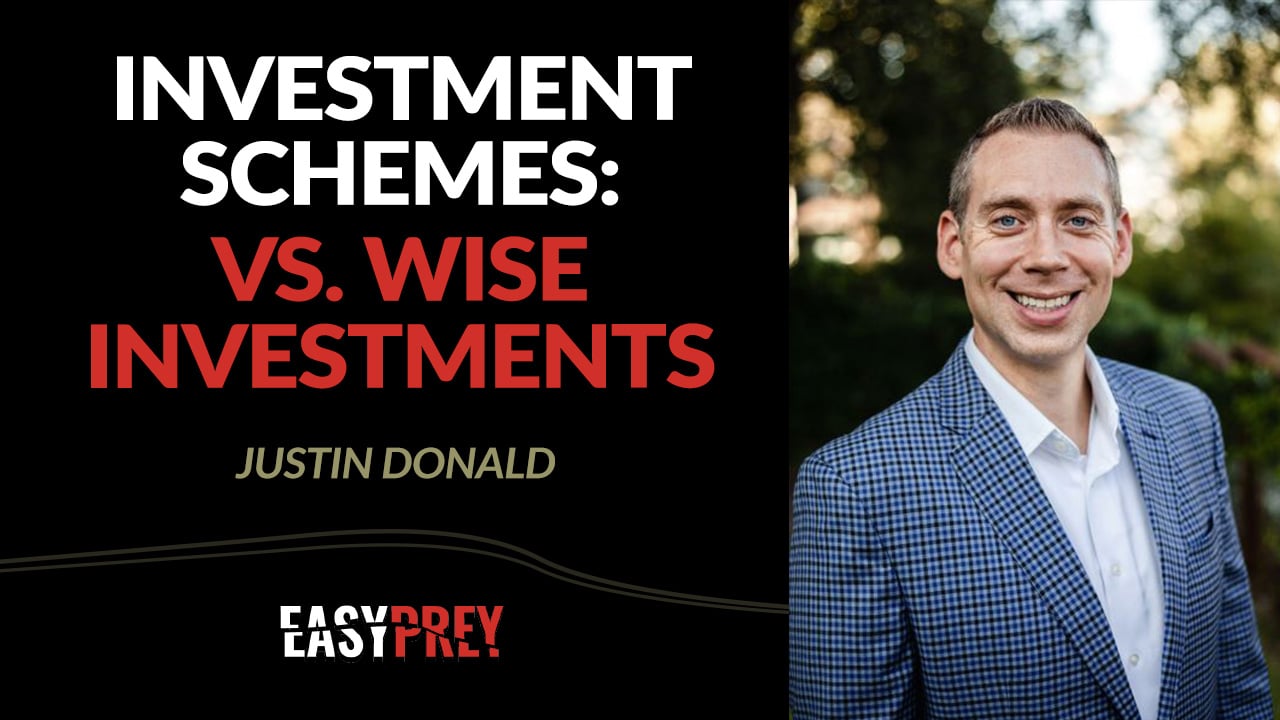
Investing can be a path to wealth or a way to lose money. It all depends on if you can tell an investment scam from a legitimate opportunity. But how can you separate a trustworthy investment from a scam? Justin Donald has some tips for that.

See Get Rich Quick Schemes vs. Investments with Justin Donald for a complete transcript of the Easy Prey podcast episode.
Justin Donald is the host of the Lifestyle Investor Podcast and the author of the bestselling book The Lifestyle Investor: The 10 Commandments of Cash Flow Investing for Passive Income and Financial Freedom. He advises entrepreneurs, executives, and media personalities on lifestyle living, and has appeared on over a hundred podcasts, including Entrepreneurs on Fire, The Mike Dillard Show, Making Bank, and the Accelerated Investor.
Justin sees his company and book and all the other work he does as a way of giving back. Most people go through life on default, responding to outside factors instead of planning a life by design. Justin teaches people how to create a lifestyle that’s exciting, compelling, and purposeful. Anyone can have a great life today and buy assets that produce income so they don’t have to work for money, and Justin wants to teach you how.
Common Mistakes with Investing
Working with so many people on investing and lifestyle living, Justin has seen people make plenty of mistakes. He has met people who have lost millions. One person he worked with lost over nine figures of net worth. But Justin sees the same mistakes over and over, regardless of how much money you have to lose.
Reacting Instead of Planning
One of the biggest mistakes Justin sees is people making financial decisions by reacting instead of planning.
Some of the decisions people make, why they make them, how little research, time, and energy goes into it … in some cases, people just throw their money away.
Justin Donald
Some people do very little research before investing their money. Many people do none at all. These investments may do okay, or they may lose everything. Justin sees a lot of people investing in something because a friend or family member told them about the opportunity and they jump in without understanding it. If you don’t understand the investment, that’s a great way to get into a bad investment – or fall for an investment scam.
Asking the Wrong People for Advice
If you want to be successful at something, surround yourself with people who are experts in the thing you want to be good at. If you want to make good investments, find people who do investing, know investing, and have a proven track record of good investments. This is not just for your finances – whether you want to be physically, mentally, spiritually, or intellectually healthy, surround yourself with people who are doing that.

And once you have those people, ask their advice. Run your investing decisions by the people you know who are experts at investing. Don’t take advice from someone who hasn’t done the thing you want to do. Ask advice from people you know are experts.
Financial Services with Different Priorities
Wall Street gets paid whether you make money or not, and that can lead to financial services not being in alignment with their clients. In Justin’s opinion, they probably don’t have your best interests at heart. In the past fifteen years, only 5% of all money managers outperformed the S&P 500 index. That means 95% of people paying for money managers are paying more money for a worse result.
If you want to use financial services, make sure your expectations match reality. In the past ten years, the stock market has been on a boom. If you’re not making money in the past ten years, that’s a red flag. Justin won’t put any money into something a financial services person recommends unless they’ve also invested in it themselves. If they don’t believe in it enough to invest, why should he? And financial services people are really good at manipulating the numbers to make it look like they’re performing better than they are. You have to do your own math to make sure they’re really getting results.
Be Wary of These Legitimate Investments
Just because it isn’t an investment scam doesn’t mean it’s a good investment. There are some legitimate investments that Justin recommends you treat with caution.
Be wary of cryptocurrencies, NFTs, and play-to-earn gaming. Some people go into these investments as gamblers. Sometimes they make money, sometimes they lose it all. Other people do the research and decide they agree with the strategy or the utility in a particular token, and in that case, it can make sense as an investment. Not all of these projects are the same, and if you want to invest in one, you should do your research.
I think there are going to be a lot of crypto projects that fail … but I think the ones that do make it are going to do extraordinarily well.
Justin Donald
Another legitimate investment where Justin recommends caution is angel investing (investing in startup companies). There is a 96% chance the company won’t make it, and you won’t know for ten to twenty years. It’s the equivalent of giving a 0% loan for an undetermined period. Angel investing is generally a poor investment unless you know what you’re doing, you have some insider knowledge, or you’re investing in enough companies that you only need one success to win.
High-risk investments are the last place Justin invests. His first priority is cash flow, then other assets that he knows will appreciate and give a good return. If you want to invest in something high-risk after you have that foundation, that’s fine. But high-risk investments shouldn’t be your only investments.
Buy an Investment, Not a Job
A lot of people invest because they want to live on passive income. Justin sees many of these people leave their corporate jobs only to buy another job. They invest in a business or in real estate, and those investments end up running them. They want more passive income, add more income sources, and all of the sudden it’s a full-time job just managing their investments.
Some people are perfectly fine with spending that time managing their investments. Justin would rather not. For him, investment is a way to enable him to do the things he wants to do.
When you can truly buy your time back and you can focus on what it is that’s going to bring you the most joy, that’s an incredible place.
Justin Donald
Get-Rich-Quick Investment Scams
Sometimes there’s a fine line between legitimate high-risk investments and get-rich-quick investment scams. If you’re open to high-risk investments, it’s essential to be able to spot the difference.
Common get-rich-quick investment scams Justin sees are initial offerings. Cryptocurrency ICOs, or Initial Coin Offerings, are very high-risk. Many of these are pump-and-dump schemes that only do well for a short period of time. Companies going public can also have the same problem.
Anything that promises guaranteed returns should also be viewed with suspicion. It’s very, very hard to get guaranteed returns. If an investment offers guaranteed returns, it’s time to start asking questions. How is it guaranteed? What is it guaranteed by? Is it backed by collateral? How are you protected if something goes wrong?
Any time you have a guaranteed return, you should probably dig deeper because guaranteed returns are hard to come by.
Justin Donald
As the old adage goes, any time something sounds too good to be true, it most likely is.
Identifying “Too Good to Be True”
If you’re not experienced at investing, it can be difficult to determine what is an investment with a good payoff and what’s actually too good to be true. For Justin, anything promising returns above the norm should be investigated.

It’s also suspicious if it claims no risk or virtually no risk. While it is possible to de-risk a deal, there will always be some element of risk in a legitimate investment. If an investment promises you great returns and no risk, it’s probably an investment scam.
Anytime I see something that is being projected above the standard of the norm in that industry, my antennas go up.
Justin Donald
Justin knows what to look for because he’s lost money. In his book, he discusses how he made poor choices and invested in a Ponzi scheme. He didn’t see the signs then, but he definitely would have done it differently now. Looking back, that was a “too good to be true” situation.
A lot of people fall prey to the fantasy of amazing returns. You can dream about that money all you want, but the return isn’t real until you get your money back. Some investments require time before you get your money back – and that’s not necessarily a red flag, but one of Justin’s ten investing criteria is to look for the principal to come back quickly. Having a quicker return de-risks the deal.
Tips to Avoid Investment Scams
When you see an investment that promises big rewards for minimal risk, it’s easy to be dazzled. We get caught up in the opportunity and potential benefit, and don’t tend to wonder if it could be an investment scam. But whenever your money is at stake, don’t jump in based on the promise of reward. Use these tips to avoid falling for an investment scam.
Look at the Worst-Case Scenario
Looking at every investment opportunity as if it is guaranteed to fall apart is a much different perspective than if you start from assuming it will work. It enables you to get a clearer look at what the risk is and how much you stand to lose.
Does this put me in financial peril so that if I lost it, my life would be massively impacted? That might be too much to invest.
Justin Donald
Ask whoever is offering you this opportunity about the worst-case scenario. Would you lose all your money? Lose part of it? Lose none? Find out how much risk is involved. Lots of people fall for big returns, but big returns tend to offer higher risk.
If you’re going to invest an amount that would have an impact and there’s potential to lose it all, this is the time to reconsider. If you still want to go with that investment, scale back the amount. Or invest in something safer. Choose an asset that holds value and won’t go to zero, so even in the worst-case scenario you’ll get something back.
Be Wary of Targeted Returns
A targeted return is just a projection of what the person presenting the investment hopes will happen. It’s just a way for them to sell it to you – it means nothing. Don’t look at big targeted returns and get your hopes up. There’s no guarantee that number will work out.
If someone comes to you with an investment opportunity, rather than asking the targeted return of the current opportunity, ask the targeted return of their last deal. Find out if everything went to plan, and how far off their projections were. That will give you a better idea of how far off the current targeted projection will be.
Take a look at their track record even past their last deal. Justin likes to look at track records for the past twenty or thirty years – through the 2008 crisis or all the way back to the dot-com bubble. He wants to see that they have invested through rocky times, if they lost money, how they responded to losses, and what they learned.
Don’t Let the Numbers Lie
If you invested $100,000 and lost 50%, you now have $50,000. If you then gain 50%, you’ve made $25,000, so you now have $75,000. It looks like you’re back to your starting point if you look at the percentages – it went down 50% and then back up 50% – while in reality, you have $25,000 less than you started with. The average rate of return is zero (+50% and -50%), but the actual return is -25%.
People pushing investment scams are good at doctoring the numbers. They can choose the right benchmarks and present them in the right way so it looks like they are making profits when they’re really losing money. Look at total amounts, not percentages. And you can always do your own math to double-check that this is a legitimate investment and not an investment scam.
Keep your investments safe
You spend most of your adult life saving for retirement, assuming that the money you put away in an investment account or a 401(k) will be safe. But your investment account is like your bank account or any other online account you have. It can be hacked. If someone gains access to it, they can drain your savings or worse — start trading in your name.
You should be on the lookout for potential hacks and security breaches with your investment brokerage accounts. And you should know what to do if you do get hacked
How brokerage account hacks happen
Let’s make one thing clear upfront: hackers can get into your brokerage account. Banks and investment firms have strong cybersecurity measures in place. But if you do not take precautions to keep your own account safe, then you risk being hacked.
One of the most common ways hackers take control of brokerage accounts is by sending fraudulent emails with malicious links. They create an email that looks like it came from your investment firm. It includes a link to a fake or malicious website. On this illegitimate website, it might ask you to enter your account credentials, which the hacker then steals. They now have access to your account and can transfer all your stocks out or sell them all.
Another way hacks happen with brokerage accounts is with data breaches. The financial services industry is an obvious target for cybercriminals because these companies handle large amounts of customers’ money. They also gather a great deal of personal information on their customers.
Here are some of the biggest data breaches in financial services that happened within the last 20 years:
- In 2020, Experian experienced a data breach that impacted 24 million customers. It releasing information such as mobile phone numbers, email addresses, residential addresses, and places of work.
- The Equifax data breach in 2017 exposed the information of 147 million customers. Some of the data compomised included names, dates of birth, Social Security numbers, driver’s license numbers, and credit card numbers.
- In 2008, Heartland Payment Systems was hacked and 100 million debit and credit card numbers were released.
- Capital One suffered a stolen data dump in 2019. It exposed 140,000 Social Security numbers, 1 million Canadian Social Insurance numbers, and 80,000 bank account numbers.
If you hold a brokerage account with an investment firm, you should know both you and your firm could be targeted by hackers.
The signs your investment account has been hacked
Hackers are sneaky. Their goal is usually to sneak into your account so they can steal your information and do as much damage as possible. That’s why it pays to be vigilant and keep an eye out for the following signs that someone has hacked your investment account:
- Unfamiliar trades. Make sure you confirm each trade listed in your account history. If you see any you don’t recognize, or you receive an email confirmation for a trade you did not execute, it’s possible your account has been hacked.
- The website is “down for maintenance”. If you are in the process of logging into your account on your investment firm’s website and you see a message saying the website is down for maintenance, it could be a man-in-the-middle attack. This type of attack lets a hacker steal your credentials as the system is sending them to the firm’s website. If you notice something like this, alert your investment firm immediately.
- You’ve been hacked once before. If your personal information has been compromised once before — whether with your investment account or another online account — you’re at risk of being hacked again. This is also true if you have had your info exposed in a data breach. Be extra cautious with your brokerage account.
- Junk mail related to investments. Are you receiving a bunch of offers for opening a new investment account? It’s likely a sign that someone opened a new account using your information.

How to prevent a brokerage account hack
The guidelines for keeping your investment account safe are the same as for any other online account. If you already practice good personal cybersecurity in general, then these tips probably aren’t news to you. If not, you’ll definitely want to read and implement the following tips from the US Securities and Exchange Commission (SEC):
- Use a strong password. The password should be a random series of at least 16 letters, numbers, and punctuation marks. You can use a password manager to generate a strong password and store it so you don’t have to try to remember it.
- Change your password often: Update your password every 2-3 months. If a data breach exposes your credentials, changing your password will protect you.
- Enable two-factor authentication (2FA) or multi-factor authentication (MFA). Your investment firm should have 2FA or MFA available as a secure login option. It requires a second form of identification from you in addition to your password.
- Activate alerts. Turn on or opt into account alerts so you receive notifications of account logins, failed login attempts, password changes, updates to personal information, transactions, and other events. If something suspicious is happening, you’ll know right away.
- Avoid public Wi-Fi and computers. Try not to access your investment accounts using a public computer or when connected to a public Wi-Fi network. If you do need to use a public computer, never walk away from it while you’re logged in, disable password saving, and delete the web browser’s history, caches, and cookies. If you must use a public Wi-Fi network to check your accounts, use a VPN.
- Don’t click on links. If you receive an email, text message, or another form of communication about your investment account containing a link, do not click on that link. It could lead to a bogus website that steals your credentials. It could also lead to a site that downloads malware onto your device. If the message looks like it’s from your investment firm or broker, contact them yourself to ask first.

Losing your life’s savings or having someone buy stocks you can’t afford is scary. There aren’t many protections for investment account fraud, and that’s even scarier. By staying vigilant, however, and signing up with a firm that takes security seriously, you can increase your chances of avoiding an investment account hack.
Justin Donald is the author of the book The Lifestyle Investor, which you can get for free (just pay shipping) at lifestyleinvestorbook.com. Proceeds from the book go to Love Justice International, an organization that fights human trafficking in over 20 countries. To learn more about his other programs or groups, including his blog, podcast, online course, and mastermind group, visit Justin’s site at justindonald.com.