
How to Protect Yourself from Online Dating Scams

Online dating has been around since the mid-1990s, when Match.com officially became the first website for dating online. We’ve come a long way since then. Not only can you use a website like Match.com to meet potential dating partners, but you can also download an app where simply swiping left or right on your smartphone can match you with someone.
It can be fun to “play the field” digitally, and many long-lasting, meaningful relationships have started online. But the world of online dating is also full of scammers trying to take advantage of vulnerable people looking for love. You don’t have to avoid online dating completely, but if you don’t want to fall victim to an online dating scam, it’s best to keep your guard up. You can practice these few simple safety measures.
How do online dating scams work?
Scammers on online dating sites and apps may take months to build a “relationship” with an unwitting victim. When they’ve gained your trust, they’ll ask for money, gifts, banking info, or some other personal info that they can use against you.
Whenever someone you’ve never met in person asks you for some sort of monetary benefit, it’s likely a scam. Even if you’ve been chatting online with this person for months on end, and feel like you’ve really connected with them, asking for money is always a red flag.
Protect Yourself from Online Dating Scams: Essential Safety Tips
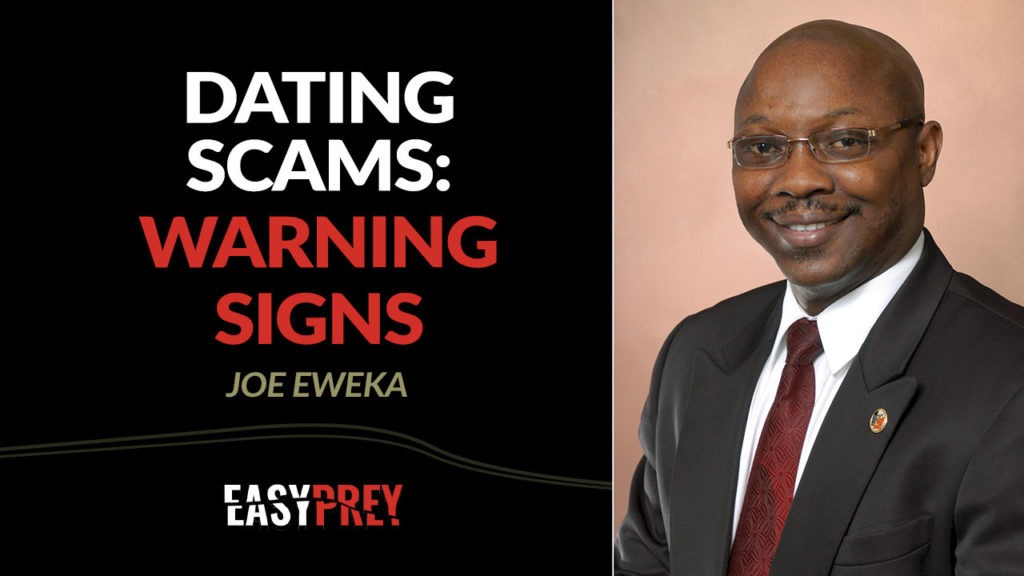
Online dating has gone mainstream. But finding love over the internet comes with risks. You could be targeted in an online dating scam.

See Dating Scams with Joe Eweka for a complete transcript of the Easy Prey podcast episode.
Joe Eweka has a Bachelor’s and Master’s degrees in criminal justice from John Jay College of Criminal Justice, a Ph.D. from Walden University, and a Master’s degree in information technology from Strayer University. He has licenses in several other disciplines, including real estate, and is certified by the Project Management Institute (PMI) as a Project Management Professional. He believes that the most important thing, after loving God, is loving our fellow man.
Joe’s interest in online dating scams started when he joined Flixter (a social-networking movie site that formed Rotten Tomatoes and was eventually bought by Fandango). He originally joined to communicate with his brother living in Italy, as making international phone calls was very expensive at the time. On Flixter, he started getting contacted by people he didn’t know. At first it was just friendship, with both men and women contacting him, but eventually the romantic propositions started. And despite his background in law and criminal justice, Joe fell for an online dating scam.
Joe realized that if he could fall for an online dating scam, anyone could. That started his interest in romance scams and the risks of dating on the internet.
I needed to put this in writing so other people will know what the dangers are.
Joe Eweka
Types of online dating scams to look out for
Online dating scams can come in different forms. The most common include:
- Requests for money: Most fraudsters on dating sites and apps are after money, gifts, or access to your financial info. They might ask you for money directly or more subtly, make hints to financial hardship. They can also make plans to come see you and ask you to pay for their airline tickets. If they ask you for any money or to pay for anything at all, it’s likely a scam.
- Extortion or blackmail: Some online relationships may turn intimate. Once the scammer has private photos/videos of you or graphic messages from you, they could use them to extort you. They may threaten to release the compromising material if you don’t pay them. This type of manipulation, known as a sextortion scam, often leaves victims feeling trapped and vulnerable, as scammers exploit their fear of embarrassment or public exposure to demand money or further favors.
- Catfishing : “Catfishing” is a term that many of us have heard. It is when someone creates a fictional persona or identity to target a specific victim or victims. It’s so dangerous because the victims are targeted specifically – the scammer has done their research and knows just what you want. The motives of catfishing can vary. Tricking you out of your money is a common one (as it is with most scams). As a romance scam, some catfishers have the goal of playing out some sort of fantasy with you. And some catfishers’ goal is just to cause you pain.

Signs of a dating scam
If you notice any of the following “telltale signs” of a dating scam on the profile of the person you’re speaking with, realize it might be a scam:
- Love bombing: “Love bombing” is when someone you’ve just met online showers you with affection and attention and seems to instantly fall in love with you. They might profess serious feelings for you right after you’ve met. If someone does this, they are probably a scammer.
- See how they react if you have no money: Since one of the most common goals of online dating scams is getting money, try to subtly suggest you don’t have a lot of money. Casually mention you’re stressed about having a lot of bills to pay, for example. Then see if they keep talking to you afterward. If they are a scam artist and realize you don’t have money, they’ll stop talking to you.
- They’ll never meet up with you in person: If someone constantly avoids meeting you in person, or cancels travel plans to come see you at the last minute, they’re likely a scam artist.
- The reason they need money is an emergency: If they claim they’re caring for a sick family member and need to pay hospital bills, or some similar situation, it’s usually a ruse. Other common stories are needing a startup loan for a business venture or funding a relative’s funeral.
- Their job keeps them overseas: A dating scammer might claim they can’t meet you in person because they have a job that keeps them overseas all the time. Examples would be a Fortune 500 company CEO, working in the military, or as an international consultant.
- Trying to lure you off the dating site or app: Any time someone tries to connect with you outside of the dating site or app, it’s a huge red flag. You should only communicate with potential dating partners through the platform you met them on in the beginning of the relationship.
- Professional-looking photo: If their profile photo looks like a professional headshot and not a casual photo, that’s a red flag. The person could just be using a professional photo of themselves rather than a selfie to look better, but they could also be a scam artist who ripped the photo from somewhere else.

Tips for protecting yourself while dating online
How can you protect yourself from online dating scams? Stick to these tips when communicating with someone on dating sites and apps:
- Never give anyone you don’t know money: In dating or anything else online, never give any money to someone you haven’t met in person. Ever.
- Don’t move too fast: Dating scam artists take advantage of people who feel lonely or vulnerable, and may try to quickly escalate the relationship. Don’t move too fast with someone you’ve met on a dating site, especially when you haven’t “met” them. Take plenty of time to get to know them.
- Don’t share personal details: Although you’re trying to get to know someone on an online dating site, don’t overshare too many personal details. You might mention interests or the industry you work in, but don’t tell someone exactly where you work or live. Also, avoid giving the names of any of your friends or family. Don’t share information that could make it possible for the other person to track you down.
- Report fake profiles: If you do come across a fake profile, report it to the dating platform. Doing so helps root out scam artists and makes it harder for them to try their scheme out on someone else later on.
- Avoid saying you’re “serious”: If you say on your dating profile that you’re looking for a serious relationship, it could come off as a sign of desperation or vulnerability to scam artists. It might make scammers more likely to target you.
- Reverse-image search their dating app photo: When you’re unsure about someone on a dating app or website, download their photo and do an image search of it. If any results come up showing the photo attached to several different names or showing it’s a stock photo, stop speaking with the person.
How to Avoid Getting Caught in an Online Dating Scam
Even the smartest person can fall for an online dating scam. If you want to avoid falling for one, or think the person you’re talking to online might not be who they say they are, Joe suggests these do’s and don’ts to keep yourself safe.
1. Don’t accept friend requests from people you don’t know on social media.
This reduces the risk of catfishers being able to contact you in the first place.
2. Don’t reveal your sensitive personal information on social media/dating sites.
Joe recommends not even giving your real date of birth to any social media site.
3. Don’t click on links or downloads in online dating profiles or sent to you by a message on a dating site.
Joe recommends always using a laptop or desktop computer. Mobile devices are convenient, but on a computer, you have the ability to hover your cursor over a link and see where the link goes. That way you can check and see if it’s suspicious or malicious before you click.
4. Don’t assume you’re safe because you initiated contact.
Just like some predators in the animal kingdom wait for their prey to come to them, some cybercriminals create the perfect profile and then wait. Their victim – you – comes to them. You take the bait, and they will swallow you.

5. Do beware of too many compliments, especially flirtatious ones.
You can copy and paste specific compliments into search engines. Some of them may show up on websites that expose scammers. If so, you’re dealing with a catfisher.
6. Do keep all of your communications on the dating site.
Many catfishers will delete their profile as soon as the conversation moves off the site so you can’t report them. Don’t let them convince you to switch to email, text, WhatsApp, or anything else. You can report any scammer behavior, and the site will have all the records.
7. Don’t rush.
Ask lots of questions. Repeat the same questions in different ways days or weeks later, and note any inconsistencies.
8. Don’t keep talking to people who are suspicious.
The more opportunities they have to talk to you, the more they have to convince you to fall for their online dating scam. If you are being catfished, report them to the dating website and cut off all communication with them.
9. Don’t send any compromising photos or videos.
A catfisher who is after money can use those photos or videos to extort money from you. A catfisher who just wants to hurt you can upload them to the internet for anyone to see.
10. Do take someone else along to meet someone for the first time.
Scammers don’t usually like to meet in person. But if the person you’re talking to agrees to meet, ask if you can bring someone else along for the first meeting. Someone who wants a genuine relationship won’t object. Make sure you tell people who aren’t going with you where you’ll be and who you’re meeting, just in case.
11. Don’t go to another country to meet someone you have never met in person before.
This is a general safety measure. Far worse than being scammed, someone who wants you to meet them in another country could be looking to hold you for ransom or sell you into sex slavery.
The dangers go far beyond losing your life savings – you could lose your life.
Joe Eweka
12. Do reverse image search their profile picture.
Google knows everything – if the picture has been used elsewhere, Google will find it. Do this before getting involved with anyone you meet online.
13. Do a background check.
If you’ve decided someone looks like a good match and they don’t seem to be a scammer, do a background check on them. Do this before getting emotionally involved, and definitely do it before meeting in person.
14. Don’t use online dating.
Joe recognizes he’s a little old-fashioned, and you’re free to do whatever you want. But personally, he doesn’t think the risks of online dating are worth the potential rewards.
In my unasked little view, if you want to date, it is better to date someone you already know.
Joe Eweka
15. Do report scammers to the Federal Trade Commission and to the FBI’s Internet Crime Complaint Center.
File a report with the Federal Trade Commission here.
File a report with the FBI’s Internet Crime Complaint Center here.
Joe Eweka is the author of Confessions of a Lonely Lover: An Exploration of Online Dating Scams and is known in the music industry as African Joe.
Don’t just avoid online dating scams
Not everyone who uses dating websites and apps is a scam artist, so you shouldn’t avoid using these platforms for this reason. As long as you’re careful and prudent about who you speak with and how much information you share on a dating site, you should be able to protect yourself from a scam.
If you want to learn more about online dating scams, listen to some of our Easy Prey podcast episodes on the subject: