
Free VPN vs. Paid VPN: What’s the Difference? And Is a Paid VPN Worth It?
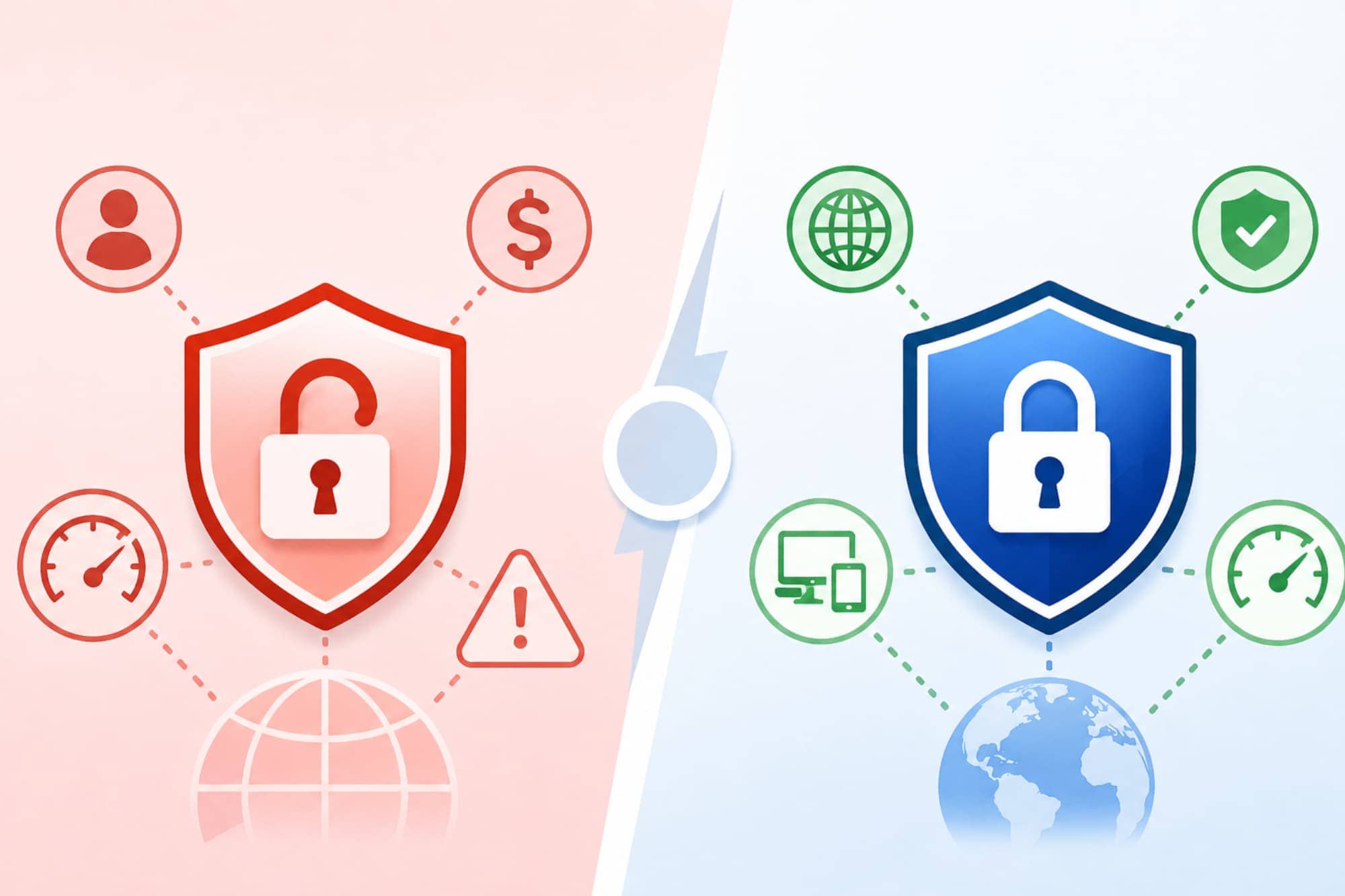
You’re about to set up a VPN. You search for options, and immediately you see a free one. No subscription, no credit card, no commitment. Seems like a good deal, so…why would you ever need to pay for a VPN?
With countless free VPNs out there, it’s easy to assume someone’s done the vetting for you. With so many options, downloads, and five-star reviews, they should be legit, right?
The sheer number of free VPNs isn’t a sign they’re safe to use, though. Building and running a VPN service costs real money. When a provider offers it for free, something is paying for it (and that something is usually your data).
Paid VPNs aren’t perfect either, but the best ones deliver something a free version rarely can: real privacy.
Here’s everything you need to know when evaluating a free vs paid VPN, and how you can choose the right one for your needs.
What’s the Difference Between a Free VPN and a Paid VPN?
At their core, both types of VPN do the same thing: they encrypt your internet connection and mask your IP address. But that’s where the similarities largely end.
The differences in how they’re built, funded, and operated have real consequences for your security and privacy.
Here’s a side-by-side breakdown of what you’re actually comparing:
| Feature | Free VPNs | Paid VPNs |
| Privacy | May sell your data to advertisers | No-log policy; your data stays yours |
| Security | Weak or inconsistent encryption | Strong encryption (AES-256); kill switch |
| Speed | Throttled; congested servers | Fast, optimized server infrastructure |
| Data Limits | Often capped (daily or monthly) | Unlimited in virtually all paid plans |
| Server Locations | Limited (often 5–10 countries) | Dozens to 100+ countries |
| Devices Covered | Usually 1 | 5–10+ devices on one account |
| Extra Features | Bare minimum | Ad blocker, malware protection, kill switch |
| Customer Support | None or community-only | 24/7 live support |
| Cost | Free | $2–$13/month depending on plan length |
Free VPNs have gaps in speed, server access, and features, which are inconvenient. The gap in privacy, however, is a risk.

The Hidden Cost of “Free” – How Free VPNs Actually Make Money
Despite growing awareness of the risks, about 28% of VPN users in the U.S. are still on free options, according to a 2025 survey by Security.org. It’s easy to see why: no commitment, no credit card, no monthly bill.
But there’s a reason these services are free, and it’s worth understanding before you download one. Servers, bandwidth, engineers, and security audits aren’t free; running a VPN service costs money. So where’s the money coming from?
Most free VPN providers fund themselves through one or more of these models:
- Selling your browsing data to advertisers or data brokers. This is the most common business model for a “privacy” tool (ironic, isn’t it?). Your traffic is the product.
- Flooding you with ads. Some free VPNs inject ads directly into your browsing session, or use your usage data to serve targeted advertising.
- Pressuring you to upgrade. The free tier is intentionally limited to push you toward a paid plan.
The first model is the one that should make you hesitate. If a VPN provider is logging what you do online and selling that data, using a VPN has actually made your situation worse. You’ve funneled all your traffic through a single point that’s actively monetizing it.
This isn’t true of every free VPN, though. A small number of reputable providers offer genuine free tiers (more on that below). But it’s true for enough of them that downloading a random free VPN from an app store is a real risk and not a smart shortcut.
What You Actually Get With a Paid VPN
The word “premium” gets thrown around a lot, but let’s translate paid VPN benefits into real-world terms:
Your data doesn’t get sold
Because you’re paying for the service, a reputable paid VPN provider has no financial incentive to monetize your browsing data. The best ones have independently audited no-log policies. That means even they can’t hand over your activity records, because they don’t keep any.
You’re protected on public Wi-Fi
Public networks at coffee shops, airports, and hotels are hunting grounds for data thieves. A paid VPN with AES-256 encryption means your traffic is unreadable to anyone else on that network, including the people running it.
A VPN limits what your ISP can see about your online activity
Without one, your internet service provider can see which sites you visit and, in the US, can legally sell that browsing data. With a VPN, your traffic travels through an encrypted tunnel so your ISP can see that you’re connected to a VPN server, but not where you’re going from there or what you’re doing.
You can access geo-restricted content
Want to watch content that’s only available in another country, or access a site that’s blocked in your region? A paid VPN with a wide server network gives you options that free VPNs with 5–10 server locations simply can’t match.
You get real security features
Kill switches (which cut your internet if the VPN drops, so your real IP never gets exposed), DNS leak protection, malware blocking, and multi-device coverage come standard with reputable paid providers. They aren’t add-ons; they’re baseline features.
What does all that cost? Less than most people think. According to a 2025 Security.org survey, the median monthly cost among paid VPN users in the U.S. is $10. But that’s across all plan types, including month-to-month. Paid VPNs like NordVPN, CyberGhost, and Surfshark typically run $2–$4 per month on annual plans.

Are There Any Free VPNs Worth Using?
Yes, a few. But the options are limited.
The most credible free VPN option is Proton VPN’s free tier. It offers unlimited bandwidth (rare for a free VPN), a genuine no-log policy, and is operated by the same organization behind ProtonMail, which has a strong track record in privacy.
There are tradeoffs, though:
- You’re limited to a handful of server locations
- Speeds can be slower during peak hours
- It won’t bypass streaming geo-restrictions
You can read our full review of Proton VPN to learn more.
A free tier from a reputable paid provider is the safest category of free VPN. Standalone apps marketed purely as “free VPNs” with no paid counterpart are the ones to be most cautious about, because the business model question becomes much harder to answer.
The bottom line: if your VPN use is occasional and low-stakes (checking a public Wi-Fi connection once in a while, light browsing), a carefully chosen free tier can be adequate. If you’re using a VPN regularly, for anything sensitive, or for streaming, a paid option is worth the few dollars per month.
Proton VPN is our top choice for free VPNs, but we also recommend four others in our guide to the best free VPNs if you’re curious.
Free VPN vs. Paid VPN: Which One Is Right for You?
The right answer depends on how you actually use the internet. Here’s a quick decision framework:
| ✔ Reputable free VPN is enough |
| You’re a light, occasional user. You just want basic protection when you connect to public Wi-Fi a few times a month, and privacy isn’t a major concern for your typical browsing. A free tier from a reputable provider (like Proton VPN) can work fine for this. |
| → Choose a paid VPN |
| You use public Wi-Fi regularly. If you’re working from coffee shops, hotels, or airports with any frequency, a paid VPN is the smarter call. The encryption quality and no-log policy matter more when you’re repeatedly putting sensitive traffic through unsecured networks. |
| → Choose a paid VPN |
| You want to stream geo-restricted content. Free VPNs almost universally fail at unblocking streaming services like Netflix or BBC iPlayer. If this is part of why you want a VPN, go paid. |
| → Choose a paid VPN |
| Privacy is genuinely important to you. If you’re using a VPN because you actually care about keeping your browsing activity private — from your ISP, advertisers, or anyone else — don’t use a free VPN. The data-selling risk isn’t theoretical. Pay for a provider with an independently audited no-log policy. |
How to Choose a Paid VPN (Without Overpaying)
Not all paid VPNs are created equal. Here’s what actually matters when you’re comparing options:
- No-log policy – look for one that’s been independently audited, not just self-reported.
- Strong encryption – AES-256 is the standard you want to see.
- Kill switch – cuts your internet connection if the VPN drops, so your real IP never gets exposed accidentally.
- Money-back guarantee – 30 or 45 days gives you time to actually test the service before committing.
- Server network – more locations means more flexibility for geo-unblocking and better speeds.
Annual and two-year plans typically bring the monthly cost down to $2–$4, and providers frequently run promotions on top of that. If you just pay for a month-to-month, the price goes up to $10-$16 per month.
Not sure where to start? Our VPN Simplifier can help you find the right fit based on what you actually need.

Frequently Asked Questions: Free vs Paid VPNs
Is a free VPN safe for an iPhone?
Some are, but many are not. Free VPNs on iOS have been found to have ties to data brokers and foreign entities. Your safest bet is a reputable paid VPN or a free tier from a known provider like ProtonVPN.
Can a free VPN actually hide my IP address?
Yes, most free VPNs do mask your IP address. The real concern is what else they’re doing with your traffic while it passes through their servers.
What does a paid VPN protect me from?
Paid VPNs protect you from surveillance on public Wi-Fi, ISP tracking, and IP-based location targeting, and some offer built-in malware protection as well. They don’t protect against phishing, weak passwords, or unsafe downloads, though. A VPN is one layer of security, not a complete solution.
How much does a good paid VPN cost?
Reputable paid VPNs typically run $2–$4 per month on annual or two-year plans, and $10–$16 per month if you pay month-to-month. Most offer a 30- to 45-day money-back guarantee, so you can try one before fully committing.
What’s the best free VPN option?
ProtonVPN’s free tier is the most credible option with unlimited bandwidth, no ads, and a genuine no-log policy. The tradeoff is limited server locations and no geo-unblocking.